
By Colby Lewis, The Law Offices of Colby Lewis, 815 Walker St., Suite 452, Houston, TX 77002
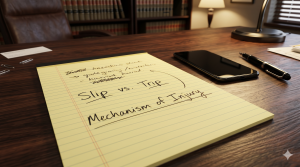
Determining the exact mechanism of injury during intake is where a slip and fall case lives or dies.
In Part 1 of this series, I covered the foundational framework for STF litigation: the standard of care, the negligence elements, and why the mechanism of injury determines your entire case theory. In Part 2, I broke down the specific consensus standards, the science behind coefficient of friction testing, and the expert witness landscape. If you have not read those, start there.
This post is the operational piece. It translates everything from Parts 1 and 2 into a working case strategy you can use the next time a slip, trip, or fall matter comes across your desk. I am going to walk through how I approach these cases from the first phone call through the demand, including the specific discovery requests, the deposition questions, the expert retention timeline, and the mistakes I have watched other attorneys make that cost their clients real money.
Step 1: Get the Mechanism Right Before You Do Anything Else
This is where the case lives or dies, and it happens at intake. When a potential client calls and says they slipped and fell at a grocery store, your first job is not to sign them up. Your first job is to figure out what actually happened.
Was it a slip? The foot lost traction on the walking surface because the coefficient of friction was insufficient. That points you toward wet floor conditions, contaminated surfaces, improper floor maintenance, inadequate matting, and the NFSI B101.1 and B101.3 standards.
Was it a trip? The foot struck or caught on an obstruction or elevation change. That points you toward damaged flooring, buckled mats, unmarked elevation changes, threshold transitions, and the NFSI B101.9 and ASTM F-1637 standards.
Was it a stumble on a sticky surface? An air step off an elevated walkway onto a lower surface without warning? A fall on a single step that lacked visual distinction? Each of these is a different case with different applicable standards, different expert requirements, and different discovery targets.
I have seen petitions alleging a slip and fall when the facts clearly showed a trip and fall. That is not a technicality. It sends you down the wrong path for the entire life of the case. You end up requesting the wrong documents, retaining the wrong expert, and citing the wrong standards. By the time you figure it out, you have wasted months and money.
At intake, ask the client to describe the event in their own words without using legal terminology. Ask them to describe the surface. Ask what their feet did. Ask whether they stepped down, stepped on something, caught their foot, or felt their shoe slide. If they say “my foot just went out from under me,” that is likely a slip. If they say “my toe caught on something,” that is a trip. If they say “I stepped down and the floor was lower than I expected,” that is an air step.
Get this right at the front end. Update it as you learn more. But never, ever draft a petition until you have confirmed the mechanism.
Step 2: Classify the Event Type and Map Your Standards
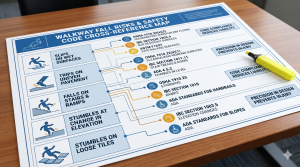
Every document request and deposition question should trace back to a specific standard on your map.
Once you have pinned down the mechanism, classify it against the 35 common STF event types. This is not an academic exercise. Each event type maps to a specific set of applicable laws, codes, and consensus standards, and knowing which standards apply to your specific case determines every downstream decision.
For example, a slip on a wet surface implicates the NFSI B101.0 (walkway auditing procedures), B101.1 (wet static COF), B101.3 (wet dynamic COF), B101.7 (footwear traction), B101.8 (floor safety management program), ASTM F-1637 (safe walking surfaces), OSHA 29 CFR 1910.22 (if a workplace), the ADA (floor surfaces shall be stable, firm, and slip resistant), the IBC (walking surfaces shall have a slip-resistant surface), the NFPA 101 Life Safety Code (slip resistant under foreseeable conditions), and the ISSA CIMS cleaning standard.
A trip on a buckled floor mat has a narrower but equally specific set: NFSI B101.0, B101.6 (floor mat safety), B101.8, B101.9 (trip hazard identification), ASTM F-1637, and the ANSI/ASSP A1264.2 (slip missteps on walking-working surfaces).
A fall in a bathtub or shower pulls in the NFSI B101.0, B101.1, B101.3, ASME A112.19.1 (enameled plumbing fixtures with slip-resistant surface requirements), IAPMO Z124.8 (plastic bath liners), the ADA, the IBC, and the NFPA 101.
Build this standards map early. Print it out. Keep it in the file. Every document request, every deposition question, and every expert opinion should trace back to a specific standard on your map.
Step 3: Build Your Discovery Plan Around the Standards
Once you know your applicable standards, your discovery practically writes itself. Here is how I approach it for a typical slip and fall in a commercial property.
Written discovery targeting the NFSI B101.8 floor safety management program.
This is the single most productive line of discovery in most STF cases. The B101.8 standard requires top management to provide an integrated management program for STF prevention, including policies, protocols, communication channels, training, equipment, and funding. It requires hard surface flooring to be tested quarterly by a competent person. It requires documented walkway audit plans. It requires cleaning chemicals and floor finishes to be certified high-traction.
Your interrogatories and requests for production should ask for: the defendant’s written floor safety management program (if one exists), all walkway audit reports for the subject location for the three years preceding the incident, all COF testing records for the subject walkway, all floor inspection logs (commonly called “floor sweep” logs) for the date of the incident and the 90 days preceding it, the identity and qualifications of the person responsible for conducting walkway safety audits, all records of floor finish and cleaning chemical products used on the subject walkway, and all certifications for those products (specifically whether they are NFSI high-traction certified).
When the defendant cannot produce a floor safety management program, or when what they produce is a one-page memo that does not come close to meeting B101.8 requirements, that gap is the foundation of your negligence argument. You are not just arguing that the floor was slippery. You are arguing that the defendant had no system in place to prevent the exact type of event that injured your client.
Written discovery targeting internal policies and procedures.
Beyond the published standards, the defendant’s own internal policies are part of the standard of care, and deviations from their own policies are powerful evidence. Request all policies related to inclement weather procedures (entranceway matting, dry mopping, sign placement), snow and ice preparation, floor mat and runner use and maintenance, floor cleaning processes and schedules, wet floor sign placement and removal, spill hazard cleanup, floor inspection frequency, and merchandising and display placement.
Here is a specific detail to watch for: most retailers do not prescribe a specific time interval for floor inspections. They will have a vague policy saying employees should “periodically” inspect floors but no documented cycle. That vagueness is useful in two ways. First, it shows the defendant failed to implement the kind of documented, periodic inspection schedule that the NFSI B101.8 standard requires. Second, it makes it nearly impossible for the defendant to prove that the floor was inspected within any particular timeframe before your client’s fall.
Targeted discovery based on incident location.
The top five locations where slips and falls occur in retail environments are building entrances, produce areas, floral departments, meat and deli departments, and dairy departments. If your incident occurred in one of these high-risk areas, request all prior incident reports for that specific area of the store for the preceding three years. A pattern of similar incidents in the same location is strong evidence that the defendant knew or should have known of the recurring hazard.
Also request the mat management records. Under the NFSI B101.6 standard, mats must be inspected regularly, replaced when they ripple, curl, or have torn edges, removed when saturated, and placed only on clean, dry, slip-resistant surfaces. If the incident involved an entranceway and the defendant’s mats were inadequate, saturated, or missing, you need to document the gap between the B101.6 requirements and what was actually happening on the ground.
Step 4: Deposition Strategy That Builds Your Record

Depositions must establish what the defendant was required to do under the standards versus what they actually did.
Your depositions should be structured to establish three things: what the defendant was required to do under the applicable standards, what the defendant actually did, and the gap between the two.
The corporate representative deposition
is where you build the record on the defendant’s safety program (or lack thereof). Before the deposition, prepare a deposition notice under Rule 199.2(b)(1) specifying topics that correspond to each element of the B101.8 standard. Specifically, designate topics covering the defendant’s floor safety management program, walkway audit procedures and frequency, COF testing history for the subject location, floor inspection protocols and logs, employee training on slip, trip, and fall prevention, mat management policies and inspection schedules, cleaning chemical selection and traction certification, and incident investigation procedures.
Most corporate representatives will not be able to answer detailed questions about these topics, because most property owners do not have programs that meet the B101.8 standard. That inability to answer is itself evidence. When the corporate representative says “I’m not aware of any quarterly COF testing program” or “I don’t know if our floor finish is high-traction certified,” those admissions go directly into your demand letter and your expert’s report.
The store-level employee depositions
are where you establish what was actually happening on the day of the incident. Focus on inspection schedules (was the floor inspected before the incident, when was the last inspection, who performed it, is there a log), spill response (how quickly was the spill or hazard identified, was an employee stationed at the hazard until cleanup, were wet floor signs placed), mat condition (were mats in place, were they dry, were they lying flat, were edges curled or buckled), and notice (how long had the condition existed, had anyone reported it, had there been prior incidents in the same location).
Step 5: Make the COF Testing Decision Early

Always use an independent Walkway Auditor Certificate Holder for COF testing to avoid conflicts of interest.
Whether to test the walkway’s coefficient of friction is a strategic decision that should be made within the first 60 days of the case. There are legitimate arguments on both sides.
Testing makes sense when you need scientific evidence to survive summary judgment, when you suspect the floor’s slip resistance has been compromised by years of improper maintenance (a low-traction COF result supports an independent housekeeping violation argument), or when the flooring manufacturer has published COF data for the product that you can compare against current measurements to show degradation.
Testing is risky when significant time has passed since the incident (the COF may have changed, opening you to a Daubert challenge), when you are uncertain about the result (a high-traction reading undermines your case), or when the case theory rests more on the defendant’s failure to maintain a safety program than on the physical condition of the floor itself.
If you decide to test, two rules are non-negotiable. First, use a third-party NFSI-trained Walkway Auditor Certificate Holder (WACH), not your retained expert. Your expert testing the floor is a perceived conflict of interest that the defense will exploit. The chances of a retained expert generating data unfavorable to their client are approximately zero, and everyone in the courtroom knows it. An independent WACH has no stake in the outcome, and their results carry far more weight. Second, testing must be performed to the correct standard using an NFSI-approved tribometer. Testing to the wrong standard, a withdrawn standard, or no standard at all produces results that will not survive a Daubert challenge and can serve as the basis for summary judgment against you.
Step 6: Retain Your Expert Strategically
Expert retention timing matters. Retain too early and you risk paying for analysis before you have the discovery to support it. Retain too late and you are scrambling to meet deadlines with an expert who has not had time to do thorough work.
My approach: identify and contact a potential expert early in the case, but do not formally retain and produce a report until you have the key discovery in hand, specifically the defendant’s safety program documents (or confirmation they do not exist), the inspection logs, the incident history, and the COF testing data (if you elected to test).
Hire a specialist in walkway safety with appropriate education, training, and experience. Not a generalist safety consultant who dabbles in premises cases. Not a mechanical engineer who overcomplicates straightforward matters with irrelevant measurements. Not a human factors expert who focuses on the plaintiff’s gait instead of the environmental conditions. And not an architect who can speak to building codes but lacks the safety background to testify about the reasonableness of the defendant’s maintenance practices.
Your expert’s role is to apply the applicable consensus standards to the facts of your case and opine on whether the defendant’s conduct met or fell below the standard of care. Their opinions must be supported by science, published research, and nationally recognized consensus standards. If your expert cannot trace each opinion back to a specific standard, that opinion is vulnerable.
One more point on experts: if the opposing expert cites the TCNA A326.3 as establishing the standard of care, be ready. That standard’s own disclaimer explicitly states that it does not address safety issues or applicable regulatory requirements. It is a ceramic tile quality control standard published by a trade association, not a safety standard. Any expert relying on it as the primary basis for a standard of care opinion is standing on ground that collapses under cross-examination.
Step 7: The Mistakes That Kill Cases

Preparation is not optional. It is the difference between a favorable settlement and dying on summary judgment.
After years of handling these matters, certain patterns emerge. Here are the errors I see most frequently, drawn directly from the cases that go sideways.
Misidentifying the mechanism of injury. Alleging a slip when the facts show a trip. This sends the entire case down the wrong path, with the wrong standards, the wrong expert analysis, and the wrong discovery. Confirm the mechanism at intake and update it as the facts develop.
Failing to request the floor safety management program. If you do not ask for it, you cannot use its absence. The B101.8 standard defines what a comprehensive program looks like. Request it, and when the defendant cannot produce one, that absence becomes a centerpiece of your case.
Having the retained expert perform COF testing. This is a credibility killer. The defense will argue bias, and they will be right. Use an independent WACH and let your expert interpret the results.
Citing the wrong standards. Slip standards do not apply to trip cases and vice versa. The NFSI B101.1 and B101.3 measure slip resistance. The NFSI B101.9 and ASTM F-1637 address trip hazards. Using the ADA as a civil rights violation instead of as a standard of care violation in a non-disability case is another common misstep. OSHA can be cited for standard of care purposes in areas open to both workers and guests, but only if the protected class analysis holds up.
Relying on general negligence arguments without citing specific standards. Telling a jury “the floor was slippery” without pointing to a measurable, published standard that was violated is not a winning strategy. The standard of care is defined by standards. Without them, you are asking the jury to take your word for it.
Ignoring the defendant’s own policies. Internal policies and procedures are part of the standard of care. When a defendant violates their own written protocols, that is often more persuasive to a jury than violations of published industry standards, because it shows the defendant knew what they were supposed to do and did not do it.
Letting too much time pass before preserving the scene. Walkway conditions change. Floors get cleaned, repaired, or replaced. Mats get swapped out. Inspection logs get overwritten. Send a preservation letter immediately upon retention and get your WACH to the scene as soon as possible if COF testing is part of your strategy.
The Bottom Line
Slip, trip, and fall cases reward attorneys who treat them as technical, standards-driven litigation rather than simple premises liability matters. The framework is straightforward: identify the mechanism, map the applicable standards, build discovery around those standards, depose to establish the gap between what was required and what the defendant did, and retain a specialist who can tie it all together with credible, standards-based opinions.
These cases rarely go to trial. Most are settled. The question is whether they settle on terms that reflect the strength of your record or on terms that reflect the weakness of your preparation. Every step in this playbook is designed to build a record that gives the defense a reason to write a check rather than a reason to file for summary judgment.
Preparation is not optional in STF litigation. It is the case.
This playbook isn’t just a list of “best practices.” It’s a strategic roadmap designed to stop the defense from burying your case at the summary judgment stage. If you treat slip and fall cases as simple “wet floor” accidents, you will lose. If you treat them as technical, standards-driven litigation, you change the math entirely.
I built this strategy over 20 years in the litigation trenches, starting with a decade as a partner at a large regional defense firm. I’ve seen the “gaps” in corporate safety programs from the inside, and I know exactly how to expose them when they fail to protect the public.
About Colby Lewis

Relentless Representation from Colby Lewis
Colby Lewis is the founder of The Law Offices of Colby Lewis in Houston, practicing across the state of Texas. A seventh-generation Texan, Colby has recovered more than $200 million for his clients in high-stakes personal injury and commercial litigation.
- AV Preeminent™ Peer Review Rated: The highest possible rating from Martindale-Hubbell for both legal ability and ethical standards.
- 10-Year Super Lawyer: Selected to the Texas Super Lawyers list every year since 2016, and recognized as a Top 100 Houston Super Lawyer.
- Texas Bar College Fellow: A member for 14 consecutive years—a distinction held by fewer than 1 in 10 Texas attorneys who prioritize high-level continuing legal education.
- Technical Depth: An honors graduate of the University of Texas at Austin and the University of Houston Law Center (Top 15%), Colby also holds a technical certification in Computer Science. This background allows him to dismantle complex digital maintenance logs and tribometric data that often baffle generalist attorneys.
Colby represents clients from his office in Houston’s historic Esperson Building. If you are a colleague with a “deceptively difficult” STF matter or a potential client looking for a lead on a case that needs a technical edge, reach out for a coffee and a consult.
The Law Offices of Colby Lewis
815 Walker St., Suite 452
Houston, TX 77002
(866) 265-2948 | clewislaw.com
Colby Lewis is a personal injury attorney at The Law Offices of Colby Lewis in Houston, Texas. He handles slip, trip, and fall litigation throughout the state. Contact his office at 815 Walker St., Suite 452, Houston, TX 77002.
