
The Law Offices of Colby Lewis
Houston Commercial Litigation Attorney
Commercial litigation involves legal disputes that arise from business relationships, transactions, contracts, and operations. When these disputes threaten your company’s financial stability, reputation, or ability to operate, experienced legal representation can help you understand your options and protect your interests.
At The Law Offices of Colby Lewis, we represent Houston businesses, owners, executives, and other parties involved in complex commercial disputes. From breach of contract claims to disagreements between business partners, we focus on identifying the underlying legal issues, evaluating financial exposure, and developing strategies that serve our clients’ broader business objectives.
Attorney Colby Lewis brings experience defending major corporations and insurance companies to his work representing clients in civil litigation. That background provides valuable insight into how opposing parties evaluate liability, assess financial risk, and approach settlement negotiations.
Call (866) 265-2948 to discuss your commercial litigation matter with The Law Offices of Colby Lewis.

Commercial Litigation Is About More Than Winning a Lawsuit
For business owners, a legal dispute rarely exists in isolation. A disagreement with a contractor may delay an important project. A broken supplier agreement could affect customer relationships. A partnership dispute may interfere with everyday business decisions or threaten the value of an ownership interest.
Successful commercial litigation requires understanding not only the legal claim but also the business consequences of pursuing it.
A company may have a strong case on paper, but litigation can still create financial and operational challenges. Attorney fees, discovery costs, executive involvement, business interruptions, and the likelihood of collecting a judgment should all factor into the decision.
From Colby’s Perspective: The Strongest Legal Strategy Must Also Make Business Sense
One of the most important questions in a commercial dispute is not simply whether a company has the right to sue. It is whether pursuing litigation will accomplish the company’s objectives.
Colby’s background in civil litigation, including his previous experience on the defense side, informs the way commercial claims can be evaluated. Important considerations include:
- The strength of the evidence: Can the business establish what the opposing party agreed to do, what went wrong, and how that conduct caused measurable harm?
- The actual financial exposure: What has the business lost, what additional losses may develop, and which damages are legally recoverable?
- The opposing party’s position: What defenses might be raised, and how could they affect liability or the value of the claim?
- The cost of pursuing the dispute: Will the expected benefit justify the financial expense, management time, and disruption?
- The desired business outcome: Does the client need compensation, enforcement of an agreement, an injunction, or a way to end an unproductive business relationship?
These considerations help distinguish a lawsuit that is legally possible from one that is strategically worthwhile.
Types of Commercial Litigation Cases We Handle in Houston
Business disputes arise in many forms, and the appropriate strategy depends on the parties’ relationship, contractual obligations, evidence, and potential damages.
Breach of Contract Disputes
A breach of contract occurs when a party fails to fulfill a legally enforceable contractual obligation without a valid legal excuse.
Common examples include:
- Vendors or suppliers failing to provide agreed-upon goods or services
- Contractors failing to complete commercial projects as required
- Customers or business partners refusing to make required payments
- Disputes over contractual performance standards or deadlines
- Disagreements concerning indemnification, termination, or payment provisions
- Alleged violations of confidentiality or other contractual obligations
Not every contract disagreement automatically establishes a successful legal claim. The language of the agreement, evidence of performance, materiality of the alleged breach, available defenses, and resulting damages must be evaluated.
Practical consideration: Before filing suit, businesses should review any notice-and-cure provisions. Some contracts require written notice and an opportunity to correct a violation before certain remedies become available.
Business Partnership and Shareholder Disputes
Disputes among partners, shareholders, LLC members, and business owners can create particularly difficult legal and operational challenges.
These disagreements may involve:
- Misuse or alleged misappropriation of company funds
- Disagreements over business management and decision-making authority
- Claims involving fiduciary duties
- Disputes over ownership percentages or profit distributions
- Removal of company officers or managers
- Business dissolution, buyouts, and valuation disagreements
Ownership disputes frequently require careful examination of operating agreements, shareholder agreements, financial records, and applicable provisions of the Texas Business Organizations Code.
Business Fraud and Misrepresentation
Commercial fraud claims may arise when a party alleges that another person or business made a material misrepresentation or engaged in deceptive conduct that caused financial harm.
These matters may involve inaccurate financial representations, misleading statements during negotiations, or material information allegedly concealed during a business transaction.
However, a broken promise does not automatically establish fraud. Texas law distinguishes between contractual nonperformance and actionable misrepresentation, and the available remedies may differ considerably.
Commercial Real Estate and Construction Disputes
Houston’s commercial real estate and construction industries involve agreements between property owners, developers, contractors, subcontractors, landlords, tenants, and other commercial parties.
Disputes may involve construction delays, defective work, payment disagreements, lease obligations, contract interpretation, or allegations of misrepresentation.
Our firm also handles construction defect matters, which may overlap with commercial litigation when contractual obligations and property damage are involved.
Trade Secret and Confidential Business Information Disputes
When confidential information, proprietary processes, business data, or trade secrets are allegedly misused, businesses may face immediate financial and competitive risks.
Depending on the circumstances, legal action under the Texas Uniform Trade Secrets Act may be available. Some disputes require urgent consideration of temporary restraining orders or injunctions to prevent further disclosure or misuse.
Whether information qualifies as a legally protected trade secret depends on the facts, including the measures taken to maintain its secrecy.
How Do You Know If a Business Dispute Is Worth Litigating?
A commercial dispute may be worth litigating when the business has a legally supportable claim, sufficient evidence, meaningful damages or other available remedies, and a realistic path toward achieving its objectives.
The amount in dispute is important, but it is only one factor.
Consider a Houston business that claims a vendor’s failure to perform caused $150,000 in losses. A lawsuit may appear financially justified. However, the analysis changes if the contract contains a limitation-of-liability provision, the claimed losses are difficult to establish, or the vendor has insufficient assets to satisfy a judgment.
Conversely, a dispute involving a smaller immediate loss may justify legal action if the ongoing conduct threatens a valuable customer relationship, important intellectual property, or the future operation of the business.
From Colby’s Perspective: A Judgment Is Not the Same as a Recovery
A critical distinction in commercial litigation is the difference between obtaining a favorable judgment and actually recovering money.
Even when a court determines that a business is owed damages, collection may depend on the opposing party’s financial condition, available assets, bankruptcy status, and other legal considerations.
That is why evaluating collectability early can be just as important as evaluating liability.
For business owners, the larger question is whether the available legal remedies can produce a meaningful result. An effective litigation strategy should account for that practical reality before substantial time and resources are committed.
Five Mistakes Houston Businesses Should Avoid During a Commercial Dispute
Decisions made during the earliest stages of a business disagreement can affect the strength of a future lawsuit.
1. Continuing Informal Negotiations Without Preserving Evidence
Business owners often attempt to resolve problems through phone conversations or informal discussions. While negotiation can be productive, important statements and agreements should be documented.
Preserve relevant emails, text messages, contracts, financial records, electronic communications, and records of contractual performance.
2. Assuming the Written Contract Tells the Entire Story
Contracts are central to many business disputes, but communications, amendments, payment histories, course of performance, and other admissible evidence may also matter.
Businesses should avoid evaluating their position based on a single contract provision without considering the agreement as a whole.
3. Making Threats or Admissions During Emotional Exchanges
Disagreements between former business partners or longtime commercial relationships can become personal.
Emails or messages written in frustration may later become relevant evidence. Communications should remain professional and factually accurate.
4. Failing to Calculate and Document Financial Losses
It is not enough to claim that another party caused financial harm. Businesses generally need evidence connecting the alleged wrongdoing to legally recoverable damages.
Invoices, profit-and-loss statements, transaction records, replacement expenses, and historical financial performance may help establish losses.
5. Waiting Until the Business Relationship Completely Deteriorates
Delays may result in missing records, greater financial harm, reduced negotiating leverage, or the expiration of important deadlines.
Early legal review does not necessarily mean immediately filing a lawsuit. It can allow a company to preserve its rights while exploring negotiated solutions.
What Damages Can You Recover in a Texas Commercial Lawsuit?
The compensation and remedies available in commercial litigation depend on the legal claims, contractual provisions, supporting evidence, and applicable Texas law.
Potential remedies may include:
- Direct economic damages: Compensation for losses directly resulting from a legally established breach or other wrongful conduct.
- Lost profits: Recoverable in certain cases when the loss is legally attributable to the wrongdoing and proven with reasonable certainty.
- Consequential damages: Additional foreseeable losses that may be recoverable depending on the circumstances and contractual limitations.
- Specific performance: An equitable remedy requiring a party to fulfill certain contractual obligations when monetary relief is inadequate.
- Injunctive relief: Court orders requiring a party to stop or refrain from particular conduct when the legal requirements are satisfied.
- Attorney’s fees: Potentially recoverable when authorized by an applicable statute or enforceable contract.
Businesses should not assume that every financial consequence of a dispute is recoverable. Contractual damage limitations, causation requirements, mitigation obligations, and rules governing proof of damages may affect the outcome.
From Colby’s Perspective: Document the Loss, Not Just the Disagreement
One challenge in commercial litigation is translating a business problem into evidence of financial harm.
For example, if a supplier fails to deliver equipment, the company may believe the delay caused substantial lost revenue. But proving those losses may require more than showing that the delivery deadline was missed.
Relevant questions may include:
- What revenue would the business likely have earned without the delay?
- What expenses would have been incurred to generate that revenue?
- Could replacement equipment or another supplier have reduced the loss?
- Were other factors responsible for some of the interruption?
- Does the contract limit the types or amounts of recoverable damages?
This type of evaluation can help establish realistic expectations and identify what evidence needs to be preserved.
How Commercial Litigation Works in Houston, Texas
Commercial disputes can proceed through negotiation, mediation, arbitration, or litigation in state or federal court. The proper approach depends on the dispute and any applicable contractual requirements.
Step 1: Initial Case Evaluation
The attorney reviews relevant contracts, communications, evidence, potential claims, defenses, damages, and deadlines.
At this stage, the objective is to identify both the legal position and the practical business goals.
Step 2: Pre-Litigation Strategy
Depending on the circumstances, the next step may involve a demand letter, direct negotiations, preservation notices, or another approach designed to protect the client’s interests.
Some agreements require mediation, arbitration, or notice before a lawsuit can proceed.
Step 3: Filing and Responding to a Lawsuit
If litigation becomes necessary, the parties must determine the appropriate court and comply with applicable filing and procedural requirements.
Commercial cases may proceed in Texas district courts, federal court, or the Texas Business Court when the jurisdictional requirements are satisfied.
Step 4: Discovery and Evidence Development
Discovery may include document requests, written questions, depositions, and analysis of financial or electronic records.
Depending on the complexity of the dispute, accountants, valuation professionals, or other experts may assist in evaluating losses or technical issues.
Step 5: Settlement Negotiations or Mediation
Parties may explore settlement at various stages of the case. Mediation can provide an opportunity to reach a negotiated resolution without the uncertainty of trial.
Settlement decisions should account for the strength of the claims, litigation costs, potential recovery, and business priorities.
Step 6: Trial and Post-Trial Proceedings
If the dispute cannot be resolved, the case may proceed to trial. Depending on the circumstances, post-trial motions, appeals, and judgment enforcement may follow.
Does Your Commercial Dispute Belong in the Texas Business Court?
The Texas Business Court began operating in September 2024 to address certain complex commercial disputes. Subsequent legislation expanded aspects of its jurisdiction.
Following changes enacted through House Bill 40 in 2025, the Texas Business Court generally applies a threshold exceeding $5 million for certain qualifying disputes, subject to statutory requirements and exceptions.
Importantly, a case does not qualify for business court jurisdiction simply because it involves more than $5 million. The type of claim, parties, amount in controversy, and other jurisdictional provisions must also be evaluated.
Houston is within the Eleventh Business Court Division, which serves Harris County and other designated counties.
For qualifying disputes, an attorney can evaluate whether proceeding in the Texas Business Court is appropriate or whether another court or dispute resolution forum better serves the client’s interests.
For additional information, see Texas Government Code Chapter 25A.
How Long Do You Have to File a Commercial Lawsuit in Texas?
Many breach of contract claims in Texas are subject to a four-year statute of limitations, but the applicable deadline depends on the claim, the contract, and the circumstances.
Different rules may apply to fraud, fiduciary duty claims, trade secret disputes, and other commercial causes of action. Contractual provisions, accrual rules, and exceptions can also affect the available time.
For example, Texas Civil Practice and Remedies Code Section 16.004 establishes a four-year limitations period for certain claims, including breach of fiduciary duty. Section 16.051 provides a general four-year period for claims not otherwise governed by a specific limitations provision.
Because the correct deadline can be disputed, business owners should seek legal guidance promptly rather than assume they have four years to act.
When Should a Business Settle Instead of Going to Trial?
Settlement may be the more practical option when it provides a reasonable result without the additional costs, risks, and operational disruption of continued litigation.
However, settlement is not always appropriate. A party may refuse to negotiate reasonably, continue harmful conduct, or propose terms that fail to adequately protect the business.
From Colby’s Perspective: Litigation Strategy Should Evolve as Evidence Develops
Early case assessments are based on the information available at the time. As discovery progresses, documents, testimony, financial analysis, and expert opinions may change the parties’ understanding of the dispute.
A legal strategy should account for new evidence rather than remain tied to an initial prediction.
For example, a business may enter litigation believing that it can establish significant lost profits. If subsequent financial analysis reveals that those losses are difficult to prove, a reasonable settlement may become more attractive.
Alternatively, newly discovered documents may strengthen the business’s position and increase its negotiating leverage.
Effective commercial representation means continually evaluating the relationship between potential recovery, litigation risk, and the client’s business objectives.
Why Work With Houston Commercial Litigation Attorney Colby Lewis?
Choosing a commercial litigation attorney involves more than comparing practice areas. Businesses need counsel capable of analyzing complicated factual disputes, understanding legal exposure, and explaining how different strategies may affect the company’s future.
Colby Lewis has experience representing major corporations and insurance companies before establishing The Law Offices of Colby Lewis in 2015.
That prior defense experience provides insight into how large organizations and their legal teams assess disputed claims, evaluate evidence, and approach litigation.
His professional recognition includes selection to Super Lawyers and recognition among Houston’s Top 100 Super Lawyers, along with an AV Preeminent peer-review rating from Martindale-Hubbell.
Meet Colby Lewis
With more than a decade of civil litigation experience, Colby Lewis has earned a reputation for strategic, results-driven representation in high-stakes disputes.
His professional recognitions include:
Texas Super Lawyers
Top 100 Houston Super Lawyers
An AV Preeminent rating from Martindale-Hubbell
A “Superb” rating from AVVO
Membership in the Texas Bar College
Before founding his firm in 2015, Colby served as defense counsel for large corporations and insurers. That experience gives him an inside understanding of how businesses, carriers, and opposing counsel operate—and how to counter their tactics effectively.
Today, he uses that insight to advocate for business owners, protect commercial assets, and resolve disputes efficiently.
Over $200,000,000 Recovered for Our Clients.
A Proven Track Record of Taking on Big Hospitals and Insurance Companies
At The Law Offices of Colby Lewis, we don’t just settle for what is easy; we fight for what is fair. Our $200 million+ in total recoveries represents thousands of hours in the courtroom and at the negotiating table, ensuring that our clients receive maximum compensation.
A Reputation Validated by Peers, Judges, and Clients
With over 20 years of experience and a perfect 10.0 “Superb” Avvo rating, our firm is recognized by the legal community for its expertise and by our clients for our dedication in commercial litigation cases.
 We are honored to announce that the Law Office of Colby Lewis has been recognized by Best Law Firms® for 2026. This prestigious ranking highlights our dedication to providing top-tier legal representation in Houston commercial litigation cases.

Colby Lewis has been selected to The Best Lawyers in America, a prestigious honor based entirely on peer review. This recognition reflects his strong reputation among fellow attorneys and his proven ability to handle complex commercial litigation cases with skill and integrity.


The Law Offices of Colby Lewis is proud to be recognized by the Better Business Bureau (BBB), reflecting the firm’s commitment to ethical business practices, transparency, and exceptional client service. This accreditation demonstrates the firm’s dedication to building trust and maintaining high professional standards.
Protect Your Business. Protect Your Future. Contact Colby Lewis Today
At The Law Offices of Colby Lewis, our approach to business disputes focuses on:
- Strategic evaluation: Identifying the legal and financial considerations that matter most to the client.
- Evidence-driven representation: Developing claims and defenses around relevant documents, testimony, and financial records.
- Practical communication: Helping clients understand the available options, risks, and potential outcomes.
- Business-focused solutions: Considering settlement, enforcement, and litigation strategies in light of the client’s larger objectives.
- Trial preparation: Evaluating the evidence and legal issues necessary to prepare for contested proceedings when litigation is warranted.
Contact our Houston commercial litigation attorney today at 866-265-2948 or fill out our online form to schedule a free consultation. Our team aggressively navigates the complexities of the Houston courts to ensure that your rights are shielded and your business interests are non-negotiable.
Frequently Asked Questions (FAQs)
What types of disputes fall under commercial litigation in Texas?
Commercial litigation includes contract disputes, partnership conflicts, business fraud, vendor disagreements, real-estate related disputes, and other conflicts arising in the course of business operations.
To learn more about the types of disputes that fall under commercial litigation, click here.
Do commercial disputes always require going to court?
Not always. Many matters resolve through negotiation, mediation, or settlement discussions.
However, if the opposing party refuses to negotiate—or if your rights are at risk—litigation may be necessary. An attorney can help you determine the best approach.
Learn more about court and commercial disputes here.
How do you determine whether a commercial case is worth pursuing?
Colby evaluates each case by reviewing the strength of the evidence, the potential financial recovery or exposure, the legal issues involved, and the overall business impact. He provides an honest assessment up front—so clients know whether pursuing litigation, negotiating a settlement, or exploring alternative solutions is the most strategic path forward.
How long does a commercial litigation case typically take in Texas?
The length of a commercial litigation case can vary widely based on the complexity of the dispute, the amount of discovery required, and whether the case proceeds to trial. Some matters can be resolved in a few months through negotiation, while others may take a year or longer. Colby Lewis provides clear timelines and consistent updates so clients always know what to expect
Learn more about how long a commercial litigation case can take in Texas here.
What should I bring to my initial consultation with a Houston commercial litigation attorney?
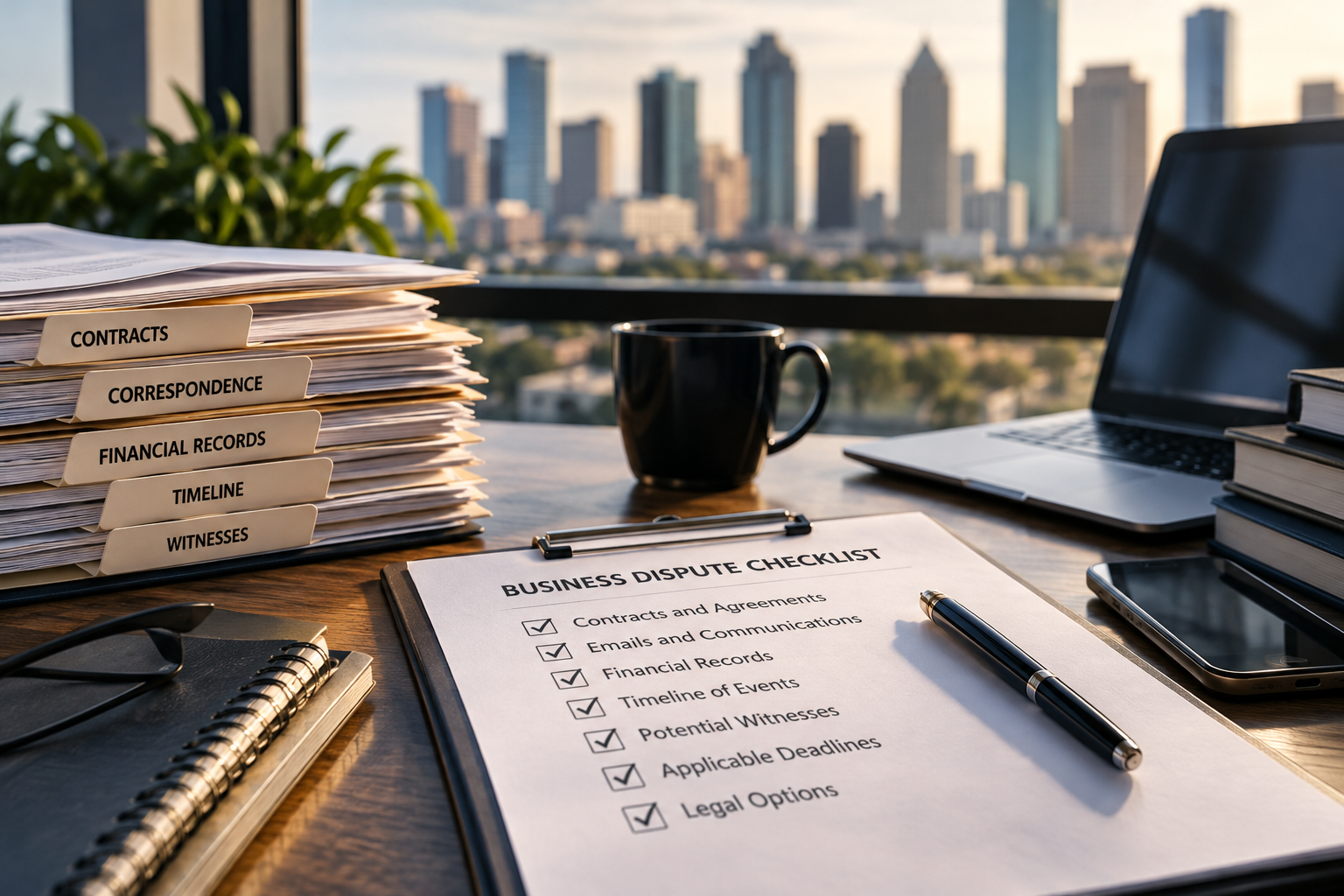
For the most productive consultation, bring any contracts, correspondence, invoices, agreements, financial records, or other documents related to the dispute. If you have emails, text messages, or notices from the other party, those are also helpful. Colby uses this information to quickly assess your position and outline your legal options.
Does you represent both plaintiffs and defendants in Texas commercial disputes?
Yes. With experience representing both sides of complex civil matters, including time spent defending major corporations and insurers, Colby Lewis brings a balanced and informed perspective to every case. This dual insight allows him to anticipate opposing strategies and position his clients for the strongest possible outcome.
How can a Texas commercial litigation lawyer help protect my business?
A commercial litigation attorney helps identify legal risks, preserve evidence, evaluate financial exposure, and develop a strategy that aligns with your business goals. Colby Lewis steps in to negotiate, litigate, or resolve disputes before they escalate—helping clients protect their financial interests, reputation, and operational stability.
Learn more about how a commercial litigation lawyer can protect your business here.
What damages can my business recover in Houston?
Your business may be entitled to:
- Monetary damages for breach
- Lost profits
- Costs related to interruption or delays
- Enforcement of contract terms
- Injunctive relief
- Attorney’s fees in qualifying cases
The specific remedies depend on the facts of your case and the terms of your contracts.
Learn more about damages you can recover here.
Why is early legal guidance so important?
- Lead to lost evidence
- Strengthen the opposing party’s position
- Trigger missed deadlines
- Increase liability
- Limit available remedies
Consulting an attorney early allows for a strategic response and preserves your rights.
Can your firm handle large-scale, high-value disputes?
Yes. Colby Lewis has significant experience handling complex business litigation, including cases involving multiple parties, substantial financial damages, and intricate contractual relationships. The firm is equipped to manage both mid-sized and high-stakes commercial matters.
Learn more about our firm here.
Top-Rated Houston Commercial Litigation Attorney on Google


Commercial Litigation Resource Blog







Contact Colby Now
Seriously injured? Or facing commercial issues? Fill out the form below and our team will be in touch with you.