
What Are the Key Slip and Fall Standards Attorneys Must Know?
The most important standards in slip, trip, and fall (STF) litigation come from the National Floor Safety Institute (NFSI), ASTM, and ANSI/ASSP. These define the standard of care and provide measurable criteria for evaluating walkway safety.
NFSI B101 Series Explained
The NFSI B101 series establishes the benchmark for walkway surface auditing and management.
NFSI B101.0 – Walkway Auditing
Establishes procedures for measuring and managing walkway slip resistance.
NFSI B101.1 – Static Coefficient of Friction (SCOF)
- 0.60+ = High traction
- 0.40–0.60 = Moderate traction
- < 0.40 = Low traction (high risk)
NFSI B101.3 – Dynamic Coefficient of Friction (DCOF)
Defines acceptable traction at 0.30 or above.
NFSI B101.6 – Floor Mat Safety
Defines proper placement, inspection, and hazard prevention for mats.
NFSI B101.7 – Footwear Traction
Classifies footwear slip resistance based on COF values.
NFSI B101.8 – Floor Safety Management Programs
Requires documented safety systems, quarterly testing, and compliance with traction thresholds.
NFSI B101.9 – Trip Hazard Prevention
Focuses on identifying and eliminating trip hazards across walkways, stairs, and ramps.
The ASTM F-1637: The Catch-All Standard for Safe Walking Surfaces
The ASTM F-1637-21 “Standard Practice for Safe Walking Surfaces” is one of the most broadly applicable standards in STF litigation. It covers design and construction guidelines and minimum maintenance criteria for new and existing buildings and structures, and is intended to provide reasonably safe walking surfaces for pedestrians wearing ordinary footwear. It addresses changes in level, carpet, mats and runners, illumination, headroom, exterior walkways, walking surface hardware, stairs, speed bumps, wheel stops, gratings, and warnings.
If you look at the matrix of 35 event types and the standards that apply to each, F-1637 shows up in nearly every row. It is the workhorse standard for STF cases and should be part of your expert’s analysis in virtually any case you handle.
The standard includes an important caveat: conformance will not alleviate all hazards, but conformance will reduce certain pedestrian risks. That language matters, because it sets a floor for reasonable behavior without promising zero risk. You can use it to argue that the defendant failed to meet even the minimum threshold for risk reduction.
The TCNA A326.3: The Most Misused Standard in Slip and Fall Litigation

The A326.3 standard contains a disclaimer explicitly stating it does not address safety issues.
This is where I see attorneys and experts go wrong more than anywhere else. The ANSI/TCNA A326.3 “Dynamic Coefficient of Friction of Hard Surface Flooring Materials Standard” is probably the most widely misinterpreted and misused standard in slip and fall litigation.
The A326.3 and its predecessor, the A137.1, are quality control standards published by and for manufacturers of ceramic tile. The Tile Council of North America is a for-profit trade association representing manufacturers of ceramic tile and related products. This is not a safety standard, and it should not be relied upon as the basis for establishing a safe walking surface.
If that does not convince you, the standard’s own disclaimer should. The A326.3 contains a “Notice of Disclaimer and Limitation of Liability” stating that the publication is provided “as is” without warranty of any kind. It explicitly states that the information “does not purport to address safety issues or applicable regulatory requirements associated with its use.” The publisher makes no representations regarding compliance with any applicable statute, rule, or regulation. The reader is “expressly warned to consider and adopt all safety precautions appropriate for the activities herein and to avoid all potential hazards,” while noting that such precautions “are generally not listed herein and are outside the scope of this document.”
When opposing counsel or an opposing expert cites the A326.3 as establishing the standard of care for floor safety, this disclaimer is your cross-examination. A standard whose own publisher says it does not address safety issues cannot be the foundation of a safety-based standard of care argument. If your expert is relying on A326.3 as a primary standard, you need a different expert.
The ANSI/ASSP Standards: Workplace and Public Safety
Two ASSP standards come up frequently. The ANSI/ASSP A1264.2 standard addresses reducing slip missteps on walking-working surfaces. Originally limited to workplace injuries, it has expanded to cover non-workplace injuries as well, which makes it applicable in a broader range of cases. It covers walking-working surface selection, test procedures, housekeeping, floor mats and runners, warnings and barricades, inherently slippery environments, illumination, footwear, and fall investigation and analysis.
The ANSI/ASSP A1264.1 standard covers safety requirements for workplace walking and working surfaces, including protection of floor and roof openings, wall openings, open-sided floors and platforms, railing system design, fixed stairway requirements (including tread depth, rise height, nosing, slip resistance, and uniformity of step dimensions), guardrail systems, handrails on stairways, and inspections and maintenance.
For construction-adjacent cases, the ANSI/ASSP A10.34 standard addresses protection of the public on or adjacent to construction sites, covering hazard control plans and public safety requirements.
Other Standards You Should Know
ASTM F-2966 covers snow and ice control for walkway surfaces. If your case involves a slip on ice or snow, this is the standard that outlines known methods for bringing about reasonably safe walkways where winter weather impacts pedestrian safety.
ASME A112.19.1 covers enameled cast iron and steel plumbing fixtures, including bathtubs and shower bases. It references slip-resistant surface requirements for the top surface of bathtubs.
ASME A17.3 is the safety code for existing elevators, escalators, and moving walks. It covers combplates, handrail guards, step risers, deck barricades, adjacent floor surfaces, and safety zones.
IAPMO/ANSI Z124.8 covers plastic liners for bathtubs and shower receptors. Note that this standard references ASTM F-462 for slip resistance testing, which was withdrawn in 2016 without replacement. If opposing counsel relies on this test method, it is no longer valid.
SSPC Guide 21 (now under AMPP) is a guide for evaluation of slip and fall resistance of flooring surfaces. It collects information on various standards into a single document and references the NFSI B101.0 through B101.8 as prescribed test methods for measuring slip resistance of painted surfaces.
ISSA CIMS (Cleaning Industry Management Standard) establishes criteria for cleaning organizations, including inspection protocols, technical training requirements, and entryway matting system specifications. It requires entryway matting to be ten feet long in the primary direction of travel where space allows. If your case involves an inadequate matting system at a building entrance, CIMS provides the benchmark.
Company Policies and Procedures: The Discovery Gold Mine

In discovery, request written policies for floor maintenance, spill cleanup, and floor inspection schedules.
Beyond the published standards, the defendant’s own internal policies and procedures are part of the standard of care. Given that slips and falls are the leading cause of injury across all industries, it is reasonable to expect property owners to have written safety policies covering these areas.
In discovery, you should be requesting policies related to inclement weather (entranceway matting, dry mopping, wet floor sign placement), snow and ice preparation (anticipation protocols, ice melting compounds, snow removal, increased walkway inspections), floor mat and runner use (location, application, maintenance), floor maintenance (cleaning processes and procedures), wet floor sign posting (when and where signs are required), merchandising and display placement, spill hazard cleanup (including whether employees are required to stay with a spill until cleanup is complete), and floor inspection schedules (sometimes called “floor sweeps,” which outline how frequently workers are to inspect for hazards).
Here is a practical tip. Most retailers do not prescribe a specific time cycle for floor inspections. That absence is itself a fact worth developing at deposition, because the NFSI B101.8 standard calls for documented, periodic walkway audits. If the defendant has no written inspection frequency, they are falling short of the industry standard.
Also worth noting: the top five locations where slips and falls occur in retail environments are building entrances, produce areas, floral departments, meat and deli departments, and dairy departments. If your case arose in one of these locations and the defendant did not have heightened inspection protocols for that area, you have a strong argument that the defendant failed to focus resources where the risk was highest.
Coefficient of Friction Testing: When to Do It and When to Skip It
Whether to test a floor’s COF as part of litigation is more nuanced than most attorneys appreciate, and it is somewhat controversial because the COF of a walkway can change over time. The measured COF today does not necessarily reflect the COF at the time the plaintiff fell.
That said, there are real advantages to testing. If the COF is tested per the NFSI B101.1 or B101.3 standards, the slip risk of the walkway can be scientifically defined. Low traction surfaces present the highest level of risk, while high traction surfaces present a reduced risk. COF measurements can also reveal how the floor has been maintained. Low traction floors are often the result of improper housekeeping, which is, independent of the COF number, a violation of the standard of care. And if the flooring manufacturer has published COF data for the product, current test results can be compared to the original specifications to show whether the floor’s slip resistance has been compromised.
On the other side, testing a floor years after a fall may not reflect the actual condition at the time of the event, which opens your expert to a Daubert challenge. The validity of the testing also depends on who performed it and what standard they tested to. Testing to the wrong standard, a withdrawn standard, or no standard at all will not pass scientific muster.
There is also a practical jury consideration. Jurors are often more concerned with whether the defendant’s actions were reasonable than with the technical details of COF values. They can be confused when experts get deep into tribometry. However, the judge as gatekeeper may want COF data to get past summary judgment, so the testing may be strategically necessary even if it does not feature prominently at trial.
Hiring the Right Expert Witness: The Five Types and Their Pitfalls
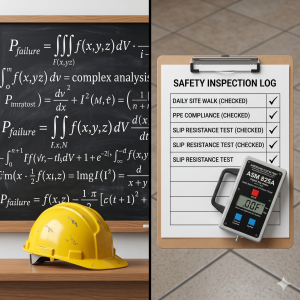
While engineers tend to present opinions in a highly technical way that confuses the jury, walkway auditors produce objective data on slip risk.
Expert selection is where I see cases go sideways most frequently. Not all experts are created equal, and hiring the wrong one can do more harm than having no expert at all.
Safety experts bring relevant training and experience but are often generalists. They tend to focus on code compliance and may lack the technical depth in walkway safety specifically. They can get you started but may not hold up under rigorous cross-examination on the science.
Engineers (usually mechanical or civil) are typically overqualified for what are generally straightforward cases. They bring unnecessary complexity, like to measure things that do not matter to the outcome, and tend to present opinions in a highly technical, theoretical way that confuses the jury. Confused jurors do not benefit plaintiffs. There are five common mistakes engineers make when testing walkway COF: using a tribometer that has not been approved by the NFSI, testing to the wrong standard, a withdrawn standard, or no standard at all, incorrectly applying test results to draw a false conclusion, confusing slip index values with coefficient of friction values, and citing false or misleading technical information found on a website. If any of these errors are present, the COF test results are unreliable and may serve as a basis for summary judgment against your client.
Human factors experts are a growing category in STF litigation. They measure gait, balance, vision, and lighting, which are important variables but rarely known or accurately measurable after the fact. No one can testify with a high degree of scientific certainty about how the plaintiff walked, their ability to balance, or exactly what they were looking at. Jurors are generally more concerned with whether an unreasonably dangerous condition was present than with the biomechanics of the plaintiff’s ambulation.
Architects and construction experts can offer perspective on building and construction codes, but because they typically lack training and experience in walkway safety specifically, they are not qualified to speak to the reasonableness of a particular environmental condition. That is ultimately what you need from your retained expert.
Walkway auditors (WACH) are technicians who measure the COF of walkways and produce objective data on slip risk. They are growing in popularity, and for good reason. Here is a critical point: do not have your retained expert perform COF testing. It is perceived as a conflict of interest, and for obvious reasons. The chances that a retained expert will test a floor and generate data contrary to their client’s case are approximately zero. Defense experts will almost always find the floors were adequate. Plaintiff experts will find the same floors were deficient. Walkway auditors do not have a stake in the outcome, and their results carry far more credibility.
If you need COF data, hire a third-party independent NFSI-trained Walkway Auditor Certificate Holder. Keep your retained expert focused on interpreting the data, applying the standards, and testifying to the standard of care.
Putting It All Together
The standards, the testing, the policies, and the experts are not separate workstreams. They are interlocking components of a single case strategy. The standards define what the defendant should have done. The company policies (or lack thereof) show what they actually did. COF testing provides the scientific evidence. And the right expert ties it all together in a way the court can rely on.
If there is one takeaway from this piece, it is this: know your standards cold before you take the deposition, before you retain the expert, and before you draft the demand. The attorney who can cite the B101.8 quarterly testing requirement, who knows that the A326.3 disclaims safety applicability in its own text, and who understands the difference between SCOF and DCOF thresholds is the attorney who controls the case. These details are not academic. They are the difference between a case that settles on favorable terms and one that dies on summary judgment.
Why the Science Matters to Me
I don’t just cite these standards—I’ve spent two decades dissecting them from both sides of the aisle. I began my career as a partner at a major regional defense firm, representing the very insurance companies and property owners I now litigate against. I know their playbook, I know how they try to hide behind the “accident” label, and I know exactly where their maintenance logs usually fall short.
In STF litigation, “good enough” isn’t a legal standard. If a defendant isn’t hitting the 0.40 SCOF floor or following the B101.8 quarterly testing requirements, they are failing the public. My job is to turn that failure into a scientific certainty for the jury.
About Colby Lewis

Relentless Representation from Colby Lewis
Colby Lewis is the founder of The Law Offices of Colby Lewis in Houston and a seventh-generation Texan. He has dedicated his practice to high-stakes personal injury and commercial litigation across the state, recovering more than $200 million for his clients.
Colby’s authority is backed by a career of consistent, top-tier recognition:
- AV Preeminent™ Peer Review Rated: The highest possible rating from Martindale-Hubbell for legal ability and ethics.
- Texas Super Lawyer (2016–2026): Recognized annually for over a decade, including being named a Top 100 Houston Super Lawyer.
- Texas Bar College Fellow: A member for 14 consecutive years, a distinction held by fewer than 10% of Texas attorneys who prioritize high-level continuing legal education.
- Technical Edge: An honors graduate of the University of Texas at Austin and the University of Houston Law Center (Top 15%), Colby also holds a technical certification in Computer Science. This background allows him to handle the complex electronic discovery and tribometric data that modern slip and fall cases require.
If you are dealing with a complex premises liability matter that requires more than just a “wet floor” theory, Colby and his team are available for consultation at the historic Esperson Building in downtown Houston.
The Law Offices of Colby Lewis
815 Walker St., Suite 452
Houston, TX 77002
(866) 265-2948 | clewislaw.com
Colby Lewis is a personal injury attorney at The Law Offices of Colby Lewis in Houston, Texas. He handles slip, trip, and fall litigation throughout the state. Contact his office at 815 Walker St., Suite 452, Houston, TX 77002.
