
By Colby Lewis
The Law Offices Of Colby Lewis
Slip, trip, and fall lawsuits are exceptionally difficult cases to win. Conversely, they are remarkably easy to lose if you are unprepared. In a personal injury lawsuit of this nature, there are truly no winners. The outcome is generally determined by which party loses more than the other.
Throughout my career handling premises liability cases in Houston and across Texas, I have seen firsthand how the initial approach to a case makes a definitive difference in the final outcome. The vast majority of slip, trip, and fall lawsuits never see the inside of a courtroom. They are settled. However, achieving a reasonable settlement quickly and affordably requires plaintiff attorneys to gather and leverage detailed, timely, and highly relevant information.
This guide serves as a roadmap for practicing attorneys to better plan their cases, understand the standard of care, and navigate the inevitable zigs, zags, and dead ends of premises liability litigation.
The Intersection of Legal and Safety Terminology

To successfully litigate these matters, counsel must bridge the gap between legal definitions and safety industry standards.
To successfully litigate these matters, counsel must bridge the gap between legal definitions and safety industry standards. Much of the terminology used in our profession overlaps with the safety sector, but the nuances are critical.
In the legal realm, negligence is defined as a violation of the standard of care. In the safety world, a hazardous or dangerous condition is specifically defined as one that is expected to cause or contribute to human injury. It is essential to argue that the failure of a property owner to provide a reasonably safe walkway constitutes both an unsafe condition and legal negligence.
We must also eliminate the word “accident” from our litigation vocabulary. As safety advocates and researchers have noted, the term erroneously implies that injuries occur entirely by chance and cannot be foreseen or prevented. We should replace this descriptor with more accurate legal and scientific terms, such as “unintentional injury,” or specify the exact injury-producing event. In almost every matter we handle, there is more than one cause or contributing factor that led to the client’s injuries.
It is also important to recognize that in the safety industry, there is no such thing as a perfectly safe or entirely unsafe walkway. Instead, walkways exhibit either a higher or lower risk of a slip or trip event occurring. Our job is to prove that the risk was unreasonable.
The Core Elements of Premises Negligence
Just because an individual is injured in a fall does not automatically mean the defendant was negligent. The plaintiff carries the absolute burden to prove that the hazard on the walkway was a definitive violation of the standard of care.
With respect to the condition of the premises, under most state laws, a defendant is considered negligent and has failed to provide a reasonably safe walkway if we can establish the following elements:
- The condition posed an unreasonable risk of harm.
- The defendant knew or reasonably should have known of the danger.
- The defendant failed to exercise ordinary care to protect the plaintiff from the danger. This failure must include both failing to adequately warn the plaintiff of the condition and failing to make the condition reasonably safe.
Pleading Precision: The Difference Between a Slip and a Trip
Once a lawsuit is filed, understanding the actual allegation is critically important. I frequently review petitions that allege a plaintiff slipped and fell, when the facts clearly dictate that the plaintiff tripped and fell.
While this might sound trivial to a layperson, this factual difference will send your litigation strategy down the completely wrong path. If the plaintiff is alleging a slip and fall, there are specific laws, codes, and nationally recognized standards that apply to that exact mechanism. If the allegation is a trip and fall, an entirely different set of standards comes into play, though a few may overlap.
You must categorize the event accurately. Falls on a level surface include slips, trips, stumbles, or air steps. These are fundamentally different from falls from elevations, which include falling down a stairway, falling off a ladder, or falling off an elevated platform. Ensure your theory of liability matches the physical reality of the incident before you draft your petition.
The Statistical Reality of Fall Causation
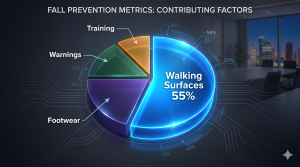
According to the NFSI, the physical condition of the floor itself is the majority cause of slip and fall incidents.
To build a compelling case, we must rely on data. According to the National Floor Safety Institute (NFSI), the primary causes of slips, trips, and falls are broken down into specific categories. Understanding these percentages helps focus discovery efforts on the most statistically probable points of failure.
- Walking Surfaces: 55%. The physical condition of the floor itself is the majority cause of these incidents.
- Footwear: 24%.
- Hazard Warning: 10%. This underscores the legal requirement to adequately warn of a dangerous condition.
- Training: 8%. A failure in employee training directly ties to a failure to maintain a safe premises.
- Fraud: 3%. Despite common defense narratives, fraudulent claims represent a tiny fraction of total incidents.
The Top 10 Factors Contributing to Slips, Trips, and Falls
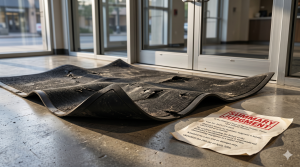
Improperly maintained mats turn safety devices into dangerous tripping hazards.
When executing written discovery and conducting corporate representative depositions, attorneys should systematically investigate the top ten factors known to contribute to these incidents.
- Failure to remove floor hazards: The most basic breach of premises maintenance.
- Unsafe or inappropriate walkway material: Using materials not suited for specific environments or traffic levels.
- Inadequate prevention policies, procedures, and employee training: A systemic failure at the management level.
- Improper equipment maintenance: This includes issues like leaking freezers or the absence of necessary containment devices.
- Failure to perform timely floor inspections: A direct violation of ordinary care.
- Failure to identify slippery floor conditions: This is often proven through a lack of periodic Coefficient of Friction (COF) testing.
- Damaged, curled, or buckled floor mats: Improperly maintained mats turn safety devices into tripping hazards.
- Failure to mark changes in elevations: Changes should be clearly marked with safety-yellow paint to provide adequate warning.
- Damaged or missing handrails or guardrails: Critical failures on stairways, ramps, or landings.
- Poor safety culture: A corporate environment that simply does not prioritize accident prevention.
Structuring Your Litigation Journey

Managing a slip, trip, and fall lawsuit requires preparing a roadmap built around established safety standards and precise factual discovery.
Managing a slip, trip, and fall lawsuit is akin to taking a journey to an unfamiliar destination. It requires preparation. Just like navigating a complex route with road closures and slow-moving traffic, litigation can be complex, time-consuming, and frustrating.
Plaintiff attorneys and defense attorneys take very different approaches to this journey. Our goal is to reach a destination of a reasonable settlement quickly and affordably. Defense attorneys, conversely, often adopt a strategy to delay the process repeatedly in the hope that the plaintiff will simply give up and go away.
To overcome these delay tactics, apply this basic roadmap to your case planning:
- Understand the Destination: Ask yourself what the applicable standard of care is for the specific incident.
- Plan the Route: Identify the applicable laws, codes, and nationally recognized standards that strictly define that standard of care. Select the appropriate standards that apply to your specific matter.
- Hire a Guide: Determine early on if you need to retain an expert witness to help interpret complex safety standards.
- Pack the Essentials: Identify the relevant discovery materials you need to collect immediately. This includes noticing key depositions, securing incident reports, and demanding all relevant photos and videos.
- Inspect the Vehicle: Decide if you need to engage professionals to test the slip resistance of the exact walkway upon which your client fell.
- Reassess when Lost: If the case develops unfavorably, or you run out of leverage, be prepared to go back to the starting point and objectively decide if the journey is still viable. The roadmap must be constantly updated to ensure the best route.
The Map is Only as Good as the Guide
I wrote this roadmap because I’ve seen too many practitioners get lost in the weeds of “general negligence” while the defense runs circles around them with technicalities. I spent the first decade of my career as a partner at a large regional defense firm. I know the defense’s delay tactics, their “investigation” shells, and their expert strategies because I used to be the one in the room drafting them.
In litigation, a map is essential, but experience is what gets you to the destination. To help visualize the most common “potholes” in these cases, here is the statistical breakdown of what actually causes these incidents:
- Walking Surfaces: 55%
- Footwear: 24%
- Hazard Warning: 10%
- Training: 8%
- Fraud: 3%
About Colby Lewis

Relentless Representation from Colby Lewis
Colby Lewis is the founder of The Law Offices of Colby Lewis in Houston, representing clients across the state. A seventh-generation Texan, Colby has recovered more than $200 million for his clients by refusing to let the defense dictate the route in complex personal injury and commercial litigation.
His authority in the courtroom is backed by a career of elite recognition:
- AV Preeminent™ Peer Review Rated: The highest possible rating from Martindale-Hubbell for both legal ability and ethical standards.
- 10-Year Super Lawyer: Selected to the Texas Super Lawyers list every year since 2016, and recognized as a Top 100 Houston Super Lawyer.
- Texas Bar College Fellow: A member for 14 consecutive years—a distinction held by fewer than 1 in 10 Texas attorneys.
- Technical Depth: An honors graduate of the University of Texas and the University of Houston Law Center (Top 15%), Colby also holds a technical certification in Computer Science. This allows him to navigate complex electronic discovery and tribometric data with a precision that few generalists can match.
Colby practices from his office in Houston’s historic Esperson Building. If you are a colleague with a “deceptively difficult” case or a potential client who needs a guide through the litigation process, reach out for a consultation.
The Law Offices of Colby Lewis
815 Walker St., Suite 452 Houston, TX 77002
(866) 265-2948 | clewislaw.com
