
A working resource for Texas plaintiff trial lawyers handling wrongful death, survival, and catastrophic personal injury claims.
The Law Offices of Colby Lewis, Houston, Texas | Texas state courts | Last reviewed: May 2026
The short answer
 After Gregory v. Chohan, 670 S.W.3d 546 (Tex. 2023), a Texas jury can no longer pick a number for mental anguish or loss of companionship and have it survive appeal on grief alone. The plaintiff must give the jury a rational reason, grounded in the evidence, for the specific amount sought. The old “shocks the conscience” review is out. A “rational basis grounded in the evidence” review is in. Unsubstantiated anchors, comparisons to fighter jets, paintings, corporate mileage, and mechanical economic-to-noneconomic ratios, are reversible error.
That is the headline. The rest of this guide explains how to build a noneconomic damages case that wins at trial and holds up on appeal, how Texas courts of appeals have actually applied Gregory through early 2026, and where the law is still unsettled.
Key takeaways
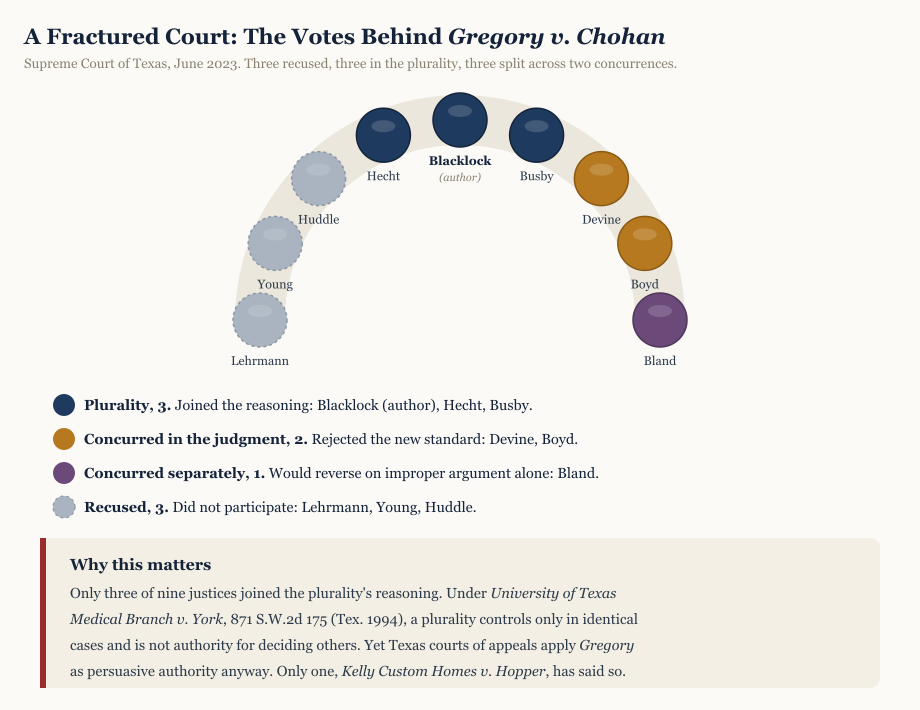
- Gregory is a plurality opinion. Three justices recused, and only three of the remaining six agreed on the reasoning. Under University of Texas Medical Branch v. York, that should strip it of binding force. In practice, almost every court of appeals applies it as if it controls.
- The plaintiff carries the burden to articulate why a given amount is reasonable and just. Detailed “nature, duration, and severity” evidence proves that anguish exists, but the plurality held it does not, by itself, justify the amount.
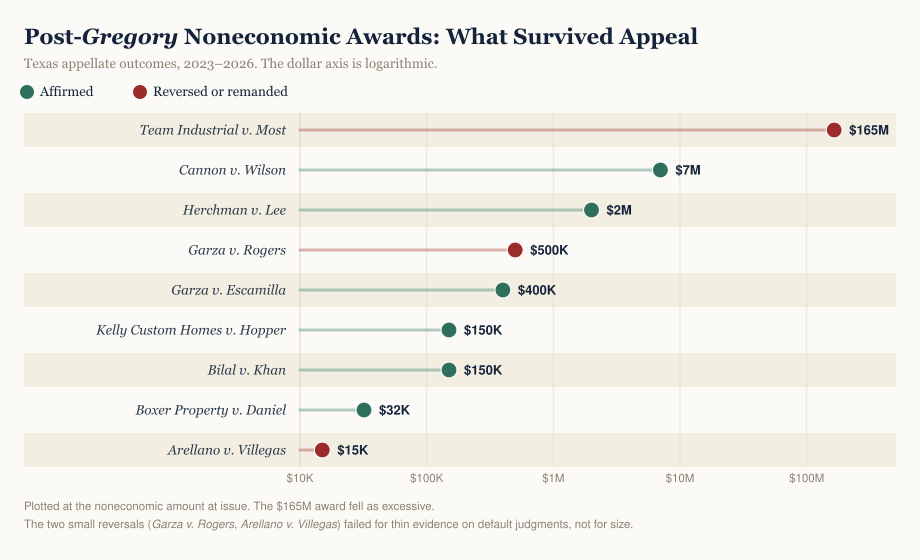
- Large, weakly supported awards are the ones that fall. A $165 million award was reversed. Awards of $7 million, $2 million, and smaller have been affirmed where counsel tied the number to the record.
- Per-diem arguments survive when grounded in the plaintiff’s lived experience. A “one dollar per waking hour” request was upheld.
- The Legislature tried to codify stricter damages rules and jury instructions in 2025 through Senate Bill 30. It failed. Gregory remains the governing framework.
What did Gregory v. Chohan actually change?
The case arose from an icy-road pileup near Amarillo in 2013. A New Prime eighteen-wheeler driven by Sarah Gregory jackknifed across Interstate 40. Bhupinder Deol stopped, left his vehicle to help other victims, and was struck and killed. A Dallas County jury awarded roughly $38.8 million across several families, with just over $15 million in noneconomic damages going to Deol’s wife, two sons, and parents. The other families settled, leaving the Deol family as the only appellees. The defendants challenged the size of the noneconomic award.
For decades, an appellate court affirmed a noneconomic award if two things were true: no extraneous evidence showed the jury acted from passion or prejudice, and the amount did not shock the court’s conscience. See Gregory v. Chohan, 615 S.W.3d 277, 314 (Tex. App.—Dallas 2020), rev’d, 670 S.W.3d 546 (Tex. 2023).
The plurality, authored by Justice Blacklock (now Chief Justice) and joined by then-Chief Justice Hecht and Justice Busby, rejected that test as too deferential. It held that a noneconomic award stands only when the amount has a rational basis grounded in the evidence. The court acknowledged repeatedly that money cannot truly compensate for grief and that exact quantification is impossible. It still required a rational reason for the number.
Here is the shift, side by side.
The first line of that table changed little. Bias and prejudice on the left map onto prohibited motives on the right. The real work happens on the second line, and that is where plaintiffs now win or lose.
A candid read: the new standard may end up close to the old one in operation. Small, well-explained awards will read as rational and get affirmed. Very large awards will read as irrational under the same reasoning that once “shocked the conscience.” The label changed. The pressure point, the size of the number relative to the proof, did not.
Is Gregory binding precedent?
Technically, no. As a practical matter, treat it as if it is.
Three justices, Lehrmann, Young, and Huddle, recused. Of the six who remained, only three joined the plurality. Justice Devine, joined by Justice Boyd, concurred in the judgment but rejected the new standard. Justice Bland concurred separately, writing that the court should have reversed on the improper argument alone and saved the standard-of-review question for another day.
That fracture matters. In University of Texas Medical Branch v. York, 871 S.W.2d 175 (Tex. 1994), the Texas Supreme Court held that without majority agreement on the reasons supporting the judgment, a plurality opinion controls only in identical cases and is not authority for deciding other cases. The court has repeated that rule. See In re State Farm Mut. Auto. Ins. Co., 629 S.W.3d 866 (Tex. 2021); Cincinnati Life Ins. Co. v. Cates, 927 S.W.2d 623 (Tex. 1996). Under York, Gregory’s reasoning should not bind anyone.
Only one court of appeals has said so out loud. In Kelly Custom Homes, LLC v. Hopper, No. 14-23-00793-CV, 2024 WL 3765393 (Tex. App.—Houston [14th Dist.] Aug. 23, 2024, pet. denied), the Fourteenth Court noted that Gregory is a non-binding plurality lacking precedential value. Every other court to cite it has applied its analysis as persuasive authority, often without flagging the plurality problem at all.
Two developments make the binding question even more live. Chief Justice Hecht, one of the three plurality votes, has retired. And the three justices who recused in Gregory would be free to participate in the next case, assuming no fresh conflict. If a clean wrongful death damages case reaches the court with a full bench, a majority opinion could harden Gregory into binding law, soften it, or push it in a direction no one predicted.
The litigation lesson is simple. Argue the York point in your own briefing when Gregory hurts you, and prepare your record as though Gregory binds the trial and appellate courts, because in practice it does.
Where did the new standard come from?
Gregory did not invent its requirements. It imported them from three lines of cases that lawyers long argued were confined to their own arenas:
- Property damage. Parkway Co. v. Woodruff, 901 S.W.2d 434 (Tex. 1995). Compensable mental anguish requires a substantial disruption in daily routine or a high degree of mental pain and distress, proven through evidence of its nature, duration, and severity.
- Workers’ compensation bad faith. Saenz v. Fidelity & Guaranty Insurance Underwriters, 925 S.W.2d 607 (Tex. 1996). Beyond proving that anguish exists, there must be some evidence to justify the amount. Juries cannot simply pick a number and put it in the blank.
- Defamation. Bentley v. Bunton, 94 S.W.3d 561 (Tex. 2002). The same principles apply.
For years, plaintiffs argued those holdings did not reach wrongful death. Gregory closed that gap. It collapsed the distinction and applied a single rule across categories: the evidence must support both the existence of the loss and the amount of the award. That is the “sea change” Justice Devine described. The concepts were not new. Their application to a grieving family’s wrongful death claim was.
What is “unsubstantiated anchoring,” and what arguments are now off-limits?
“Unsubstantiated anchoring” is the practice of suggesting a large damages figure by tying it to something that has nothing to do with the family’s emotional loss. Gregory drew bright lines around three improper tactics.
Comparisons to unrelated high-value objects. In Gregory, counsel for plaintiffs who later settled referenced a fighter jet worth roughly $71 million and a Mark Rothko painting that sold at auction for about $186 million. The plurality called these flawed analogies. The value of a jet or a painting says nothing about a family’s grief and cannot rationally connect the injury to the award.
Mileage and volume math. Counsel asked the jury to award “two cents” for each of the 650 million miles the defendant’s trucks drove in a year. The plurality held this is a punitive argument dressed as compensation. It has nothing to do with making a family whole.
Mechanical ratios. The court rejected any requirement that juries weigh a fixed ratio between economic and noneconomic damages. Emotional loss differs in kind from lost wages. The court left a narrow door open. Economic figures might bear on noneconomic harm in unusual cases, for example where a long, costly hospitalization preceded death and the medical reality informs the family’s anguish. But the unexamined use of a ratio, without case-specific reasons, cannot supply the rational connection.
The practical command for closing argument: stay inside the four corners of the evidence. The broader and more concrete your damages record, the broader your closing can run while staying rational.
What evidence does support the amount now?
This is where Gregory turns murky, and where careful trial preparation pays off. The plurality refused to list every acceptable form of proof. It pointed to a few possibilities and left the rest open.
Nature, duration, and severity. This evidence proves the loss exists, and the court said those same factors are “naturally” relevant to the amount. But here is the trap. In Gregory itself, the plurality found that the widow’s detailed testimony about her anguish and its physical toll satisfied Parkway, yet still did not justify the amount under Saenz. Even thorough nature-duration-severity proof, standing alone, may not carry the number. Plan to do more.
Financial consequences of a disrupted life. The plurality suggested a plaintiff might show the likely financial fallout of severe emotional disruption, or that some amount of money would help the plaintiff manage grief or restore emotional health, such as the cost of therapy or care. The concurrence fairly noted that those sound like economic losses, not measures of noneconomic injury, and that the suggestion ignores those who grieve deeply in private without treatment. Use it where the facts fit, but do not lean on it as a complete answer.
Comparison to awards in similar cases. In a footnote, the plurality declined to foreclose verdict comparisons as one tool to show an amount is reasonable. The language reads as an appellate tool, not a jury argument, and the court expressly declined to define its permissible uses. Useful for defending an award on appeal. Risky as a closing tactic.
The throughline the plurality stressed: a party defending an award cannot assert that the amount justifies itself because a properly instructed jury picked it. Counsel must give a reason, and the reason must be rational, reasonable, just, and grounded in the evidence. Most trial lawyers expected as much. The opinion just made it a sufficiency requirement.
The Devine-Boyd concurrence: the fault line that is not resolved
Justice Devine, joined by Justice Boyd, agreed to reverse but attacked the plurality’s standard on two fronts that every practitioner should understand, because they signal how a future court might cut.
First, determining the value of a human life to a family has always belonged to the jury. Texas has entrusted that judgment to community representatives for more than a century, upholding their verdicts whether the award was zero or substantial. The concurrence collected authority from Texas and fifteen sister-state high courts to make the point.
Second, the concurrence argued the plurality demands the impossible. Pain and grief have no market value, so no evidence can ever establish that a loss is “worth” a specific dollar figure. The plurality, in the concurrence’s words, sends litigants hunting for an evidentiary needle that does not exist.
The plurality and the concurrence share more common ground than first appears. The plurality conceded that precise quantification is not required and that mathematical precision is not the test. Both opinions agree the loss is unquantifiable. They split on what a court should do about it. That unresolved tension is exactly what a full bench may take up next.
How have Texas courts applied Gregory?
In its first two years, Gregory was cited in roughly fourteen cases, and the pattern is consistent. The single oversized verdict fell. Modest, well-supported awards held. The cases below show where the line sits.
Where the award failed
Team Industrial Services v. Most, 711 S.W.3d 31 (Tex. App.—Houston [1st Dist.] 2024). A widow recovered $165 million in noneconomic damages, split across past and future mental anguish and loss of companionship. The First Court used Gregory to hold the award excessive and unsupported, and it criticized plaintiff’s counsel for unsubstantiated anchoring in closing, even though the case was tried before Gregory condemned the tactic. Two cautions for readers. The court arguably reached the damages issue after already deciding to remand on a choice-of-law error, and it ultimately dismissed on forum non conveniens. The damages discussion is instructive but procedurally complicated.
Where the award held
Cannon v. Wilson, No. 05-23-01185-CV, 2025 WL 1372864 (Tex. App.—Dallas May 12, 2025). A $7 million bench-trial mental anguish award in a civil sexual assault case was affirmed. The plaintiff proved the nature, duration, and severity of daily trauma spanning her adolescence, including repeated abuse, pregnancies, miscarriages, and abortions. Her counsel explained, even in general terms, why the amount was just. The court found the award rational, grounded in the evidence, and free of prohibited motives, despite being larger than awards in comparable cases.
Herchman v. Lee, No. 02-22-00217-CV, 2024 WL 4898787 (Tex. App.—Fort Worth Nov. 27, 2024). The Fort Worth court affirmed $2 million in noneconomic damages for severe, permanent facial injuries from a dog attack. The plaintiff laid out the trauma and its permanence in detail, and the court applied Gregory to an extensive review of that evidence.
Garza v. Escamilla, No. 14-23-00271-CV, 2025 WL 677013 (Tex. App.—Houston [14th Dist.] Mar. 4, 2025). The court affirmed $200,000 for future physical pain and $200,000 for future physical impairment tied to seven herniated discs and their lasting effect on daily function. The defense argued unsubstantiated anchoring because counsel asked for $16 a day over 25 years and noted that society spends heavily to avoid pain. The court rejected the challenge. The message was that there is a market to avoid pain and a constitutional bar on inflicting it, which shows pain is both costly and intolerable, themes rationally connected to a personal injury claim. A simple “one dollar for every waking hour,” sixteen dollars a day, is a permissible jury tool, not an anchor.
Kelly Custom Homes, LLC v. Hopper, No. 14-23-00793-CV, 2024 WL 3765393 (Tex. App.—Houston [14th Dist.] Aug. 23, 2024). Notable as the one opinion that labeled Gregory a non-binding plurality. It affirmed a $150,000 mental anguish award in a property damage case on independent authority.
Boxer Property Management Corp. v. Daniel, No. 02-22-00336-CV, 2024 WL 3282541 (Tex. App.—Fort Worth July 3, 2024). The court affirmed a $32,000 mental anguish award in a wrongful termination case, leaning on Gregory’s acknowledgment that noneconomic damages cannot be precisely quantified.
Mixed and instructive
Bilal v. Khan, No. 05-24-00390-CV, 2025 WL 1547741 (Tex. App.—Dallas May 30, 2025). Awards of $140,000 past and $10,000 future mental anguish stood. The court applied only the nature, duration, and severity requirement, not the rational-connection standard.
Arellano v. Villegas, No. 03-23-00398-CV, 2025 WL 284912 (Tex. App.—Austin Jan. 24, 2025). On a no-answer default with only a conclusory affidavit, the court reversed a $15,000 past mental anguish award and recited pre-Gregory broad-discretion language. A reminder that thin proof fails under either standard.
Garza v. Rogers, No. 01-22-00563-CV, 2024 WL 3571549 (Tex. App.—Houston [1st Dist.] July 30, 2024). In a default judgment, an unsegregated $500,000 lump sum for pain, anguish, and impairment was remanded because the court found no mental anguish evidence and the elements were not separated.
The reverse-Gregory move
Plaintiffs have tried to flip Gregory to attack zero-dollar findings, arguing that a $0 award is not grounded in the evidence given proof of harm. So far that argument has failed. See Cannon v. Fenton, No. 14-22-00529-CV, 2023 WL 8820458 (Tex. App.—Houston [14th Dist.] Dec. 21, 2023, pet. denied); Stone v. Christiansen, No. 02-22-00450-CV, 2023 WL 5766076 (Tex. App.—Fort Worth 2023, no pet.); Wilson v. Murphy, No. 02-23-00207-CV, 2024 WL 1561468 (Tex. App.—Fort Worth Apr. 11, 2024, no pet.).
The trend continues into 2025 and 2026. Courts keep affirming modest awards built on a per-day calculation tied to documented daily suffering, and keep crediting evidence of deterioration over time. The lesson holds. Tie the number to the record, and keep the number defensible.
What about the Legislature? Senate Bill 30 and the 2025 session
A practitioner resource has to account for what almost happened in 2025.
Senate Bill 30, authored by Senator Charles Schwertner and backed by Texans for Lawsuit Reform, was the session’s marquee tort-reform effort. As to noneconomic damages, the bill would have required courts in cases seeking those damages to give the jury statutory definitions of each damage category and to instruct that awards must be fair and reasonable compensation, not a penalty or punishment, and not a valuation of human life. It would have split noneconomic damages into separate categories for physical pain and suffering and for mental or emotional anguish, and it would have added remittitur procedures for awards above certain thresholds. The bill also targeted medical-billing practices and letters of protection.
SB 30 passed the Senate but stalled in the House. The Legislature failed to agree on a final version before the session ended on June 2, 2025, and the bill did not become law.
Two points for practitioners. First, Gregory, not a statute, still governs how you prove and instruct on noneconomic damages. Second, the bill’s jury-instruction concept, defining the damage categories and cautioning against punishment, tracks where the case law is already heading. Expect a similar bill in a future session, and expect defendants to request Gregory-style instructions now, by motion, even without a statute behind them.
A practitioner’s playbook: building a Gregory-proof damages case
The goal is a record so complete that the jury can find a fair number and the trial and appellate courts have a hard time disturbing it. Five moves matter most.
1. Build the case with objective lay witnesses, not just family
Family testimony is expected and easy to discount as biased. Strengthen it with witnesses who are not related to the plaintiff, who had direct and meaningful contact, and who can give concrete examples of the grief’s nature, duration, and severity.
Mine the workplace. Grief follows people to work, where it often produces isolation and a measurable decline in performance. Supervisors and coworkers can describe specific, unbiased changes. Research on “disenfranchised grief” supports the point that mourning erodes performance and connection precisely where people are expected to hold it together.
Look to the community. Clergy, close friends, educators, and business partners can speak to visible shifts in demeanor, withdrawal, and function across every part of the plaintiff’s life.
2. Add teaching experts, not only treating clinicians
Treating doctors and therapists remain essential. But trial lawyers already use teaching experts to explain how a product failed or how a standard of care was breached. Use the same approach for grief. A published bereavement or trauma expert can give the jury a structured, peer-reviewed baseline for the progression, severity, and chronicity of profound loss. That context turns raw emotion into evidence the jury and the appellate court can evaluate.
3. Make demonstratives that map the loss
Demonstratives and exhibits that chart milestones lost, life goals cut short, and the generational impact of a broken relationship reinforce the testimony and give the jury something concrete to reason from. Demonstratives serve double duty across direct, cross, and closing. Mark them for the record, or at least photograph and mark them, so the appellate court can see how the jury arrived at the number.
4. Tailor everything to this plaintiff
Generalities lose under Gregory. The more unique and specific the proof, the harder it is to dismiss the amount as arbitrary. Build the damages story around this family’s actual life, routines, and losses.
5. Fix the jury charge
Since appellate courts now weigh nature, duration, and severity, give the jury those factors to weigh too. Consider model language adapted to the Gregory factors, drafted in your own words rather than lifted verbatim from any source:
- Damages instruction. In awarding compensatory damages, if any, you may consider the nature, frequency, duration, and severity of the physical pain or mental anguish the plaintiff sustained as a result of the occurrence in question.
- Cautionary instruction. Any award you make for compensatory damages must be for fair and reasonable compensation. You must not award or increase damages to penalize or punish the defendant.
The cautionary instruction draws on the request made in Team Industrial. It protects the record against any later claim that the verdict reflected punishment rather than compensation, which is one of the surest ways to lose a large award on appeal.
Quick reference: prohibited tactics versus approved strategies
Frequently asked questions
Does Gregory apply outside wrongful death?
Its holding addresses wrongful death, but the reasoning was imported from property damage, defamation, and workers’ compensation cases, and courts have applied it to personal injury, sexual assault, and wrongful termination awards. Expect it to reach most noneconomic damage findings.
Is a per-day or per-hour damages argument still allowed?
Yes, when it is tied to the plaintiff’s lived experience rather than to an unrelated value. Garza v. Escamilla upheld a “one dollar per waking hour” request. The key is grounding the math in the evidence, not in an outside anchor.
What is the single most common reason large awards are reversed?
The plaintiff proved that anguish exists but never gave the jury a rational, evidence-based reason for the specific amount, often compounded by an improper anchor in closing.
Did the 2025 Texas Legislature change the damages rules?
No. Senate Bill 30 would have codified stricter definitions and jury instructions, but it failed to pass before the session ended on June 2, 2025. Gregory still governs.
Is Gregory binding on Texas trial courts?
It is a plurality opinion that, under York, should not bind other cases. Only one court of appeals has said so. Every other court applies it as persuasive authority, so prepare your record as though it controls.
How we approach these cases
At The Law Offices of Colby Lewis, our Houston wrongful death attorney builds noneconomic damages proof from the first client meeting, not the week before trial. That means objective witnesses across the workplace and community, teaching experts where the facts support them, demonstratives marked for the appellate record, and a closing that ties every dollar to the evidence. The standard set by Gregory rewards preparation. We prepare for it.
