
By Colby Lewis, Managing Partner, The Law Offices of Colby Lewis
New lawyers entering the legal profession face a steep transition from law school to practice. The skills that earned high grades in law school, including exam writing, abstract legal analysis, and seminar participation, rarely translate directly into the daily demands of client representation. Every year, talented graduates stumble not because they lack intelligence but because they operate under flawed assumptions about what the profession actually rewards.
This guide draws on decades of experience in personal injury, commercial litigation, and insurance bad faith practice across Texas. It offers practical, field-tested advice on how to build trust, produce excellent work, manage your time, develop legal research skills, and navigate the rapidly evolving landscape of AI in legal practice.
 Deliver Work You Would Stake Your Name On: How Do New Associates Build Trust?
The most destructive habit a new lawyer can develop is treating the word “draft” as a shield against accountability. When you label a memo “DRAFT” and hand it to a senior attorney riddled with gaps and half-formed conclusions, you are not protecting yourself. You are announcing that you lack confidence in your own work and forcing someone else to do the thinking you avoided.
Senior lawyers notice this pattern immediately. A partner at a Houston litigation firm once described it this way: an associate handed her a research memo with a cover note reading, “I found a couple of cases but didn’t have time to check their history or finish the analysis. Wanted to get you something before the weekend.” The partner’s reaction was not gratitude for the early delivery. It was frustration that she now had to redo the entire project herself, which was exactly the work she had delegated to avoid.
The principle at work is simple. Every piece of work that leaves your desk shapes how people perceive you. Partners, supervising attorneys, and clients will associate your name with the quality of what you produce. If that association is consistently positive, you earn trust. Trust is the single most valuable currency in a law firm. It determines which assignments you receive, which cases you work on, and ultimately whether your career advances or stalls.
Identifying the Warnings: How Trust Breaks Down
Trust breaks down in specific, identifiable ways.
- You tell a supervising attorney there is no relevant authority, and she finds a case on point within twenty minutes of looking herself.
- The opposing party files a brief citing controlling precedent you never flagged.
- You rely on a trial court ruling without noting it was reversed on appeal.
Each of these failures is a withdrawal from your trust account, and the balance runs to zero faster than you expect.
The fix is straightforward. Treat every assignment as though the final product will be filed with the court under your bar number. Read it again after you think it is done. Ask yourself whether you would be comfortable if your name were the only one on it. If the answer is no, keep working.
Respect the Schedules of Everyone Around You: What Are the Realities of Litigation Deadlines?
Time management as a new lawyer is not about your schedule alone. It is about how your work habits affect every other person on the team.
Consider a concrete scenario. A motion for summary judgment is due on Monday morning. You deliver your draft to the supervising partner at 6:30 p.m. on Friday. From your perspective, you worked hard all week and met the deadline. From the partner’s perspective, you just destroyed her weekend. She now has two days to review, revise, and finalize a document that almost certainly needs substantial editing.
The better approach: deliver your draft by Wednesday. If the brief is due Monday, a Wednesday delivery gives the partner Thursday and Friday during business hours to review it, provides time for a second round of revisions if needed, and avoids forcing anyone into weekend work that proper planning could have prevented.
The same principle applies in reverse. If you are unable to complete an assignment, say so immediately. Do not wait until the deadline to reveal that the research is unfinished or the memo is not started. Early disclosure gives the team time to find another solution. Last-minute disclosure leaves everyone stranded.
A litigation paralegal at a Dallas defense firm learned this lesson the hard way in his first year. He was assigned to compile and organize trial exhibits. When the trial attorney asked for a status update at 4:00 in the afternoon, the paralegal admitted he had not started. The attorney spent the next eight hours doing the work himself. The paralegal was not invited to work on the next trial. The lesson is not complicated: if the work is not getting done, the only thing worse than saying so early is saying so late.
Understand What Billable Hours Actually Measure: Is Total Client Value Tied Strictly to Time?
New associates at firms with billable hour targets often misunderstand the purpose of time tracking. The goal is not to accumulate hours. The goal is to serve clients effectively and efficiently.
Billable hour requirements at U.S. law firms typically range from 1,700 to 2,200 hours per year, depending on firm size and market. Larger firms with more than 700 attorneys tend to require approximately 1,900 to 1,950 hours annually according to data from NALP. A 2025 survey by ALM and Law.com Compass found that 65.5 percent of lawyers reported that billable-hour pressures negatively affected their mental health, prompting the New York State Bar Association to recommend capping requirements at 1,800 hours.
These numbers matter, but they should never become the point of your work. Time recording exists for three practical purposes:
- It allows the firm to allocate costs fairly among clients.
- It provides a rough measure of the value delivered to each client.
- It helps the firm track which lawyers are available for new assignments.
That is all.
If you find yourself padding entries to meet a quota, stretching a three-hour project into five hours, or sitting at your desk doing nothing productive just to log time, you are confusing the metric with the mission. The metric is hours recorded. The mission is excellent client service delivered at a reasonable cost.
Here is a useful reframe. Think of yourself as a craftsperson, not a clock-puncher. A skilled carpenter does not measure success by how long she spends at the workbench. She measures it by the quality of what she builds. Your goal should be to produce outstanding work as efficiently as possible, record your time honestly, and let the quality of your output generate demand for your services.
One absolute rule: never inflate your hours. Billing fraud is a firing offense at every reputable firm and can result in disciplinary action from your state bar. The Texas Disciplinary Rules of Professional Conduct, Rule 1.04, requires that all fees be reasonable. Padding time entries violates that rule, full stop.
Master the Facts Before You Touch the Law: Why Is Initial Context Mandatory?
Legal research without factual grounding is wasted effort. You cannot identify the relevant legal standard until you know the facts that trigger it. You cannot evaluate whether a precedent supports your client’s position until you compare its facts to yours.
This sounds obvious, but new lawyers routinely skip this step. They receive a research assignment, open their browser, type keywords into a legal database, and start reading cases without first asking themselves: what exactly happened? Who did what, when, and where? What is the client’s objective? What is the procedural posture?
Get the facts locked down first. Read the complaint, the answer, the relevant discovery responses, and the underlying documents. Talk to the supervising attorney and ask every clarifying question you can think of. When the partner gives you an assignment over the phone and the description is vague (and it often will be), you are not merely permitted to ask questions. You are required to. A partner will only give you a clear assignment if you insist on clarity.
Once you have the facts, bring the same rigor to the cases you read. Pay attention to three categories of factual context in every precedent you rely on.
Procedural Context
Know whether you are reading a trial court opinion or an appellate decision. Know what motion or issue the court was deciding. Know whether the opinion is published or unpublished and what weight it carries.
Jurisdictional Context
If you are litigating in the Southern District of Texas, binding authority comes from the Fifth Circuit and the U.S. Supreme Court. A Northern District of Illinois opinion is persuasive at best. How you frame the authority in your brief depends entirely on its jurisdictional relationship to your court. An opinion from the relevant circuit gets cited as controlling. An opinion from another circuit gets introduced more carefully, as support for a broader consensus.
Temporal Context
Older cases can be unreliable if the governing statute, rule, or standard has changed since the opinion was issued. The Texas Citizens Participation Act, for example, has been amended multiple times since its enactment in 2011. Cases interpreting earlier versions of the statute may state rules that no longer apply. Always check whether intervening legislation or rule changes affect the continuing validity of the case you are citing.
Know What a Case Actually Decided: What Defines a Binding Legal Holding?
One of the most common and most dangerous errors new lawyers make is describing a case in terms of its broad reasoning rather than its specific holding. The holding is what the court actually did: granted or denied a motion, affirmed or reversed a judgment, sustained or overruled an objection. Everything else in the opinion is explanation, reasoning, or dicta.
This distinction matters enormously in practice. When you tell a supervising attorney that a case “stands for the proposition that” a certain legal principle applies, the attorney needs to know whether the court actually applied that principle to reach its result or whether a single paragraph of dicta mentioned the idea in passing. The difference determines how much weight the authority carries and how you present it in a brief.
Train yourself to identify the holding of every case you read by answering two questions:
- What procedural action was at issue (summary judgment, motion to dismiss, appeal from a jury verdict)?
- What did the court do (granted, denied, affirmed, reversed, remanded)?
If you cannot answer both questions clearly, you do not yet understand the case well enough to cite it.
Research Like a Professional, Not a Search Engine: What Is the Proper Legal Research Sequence?
The temptation for new lawyers is to begin legal research by typing keywords into Westlaw or Lexis and hoping for a useful result. This approach is fast, intuitive, and almost always incomplete.
Keyword searching has real limitations. It depends entirely on whether the court used the exact words you searched. Courts describe the same concept using different vocabulary. A court might call a party “the minor,” “the child,” “the juvenile,” or “the youth.” If your search uses only one of those terms, you will miss relevant authority. Keyword searches also struggle with complex legal concepts expressed in ordinary language, where no distinctive legal term exists to anchor the query.
A more reliable research method follows a structured progression.
Step 1: Secondary Sources and Practice Guides
Start with a secondary source, a treatise chapter, a practice guide, or an annotated statute, to learn the conceptual framework of the area of law. Texas Practice guides published by Thomson Reuters, O’Connor’s Texas Rules series, and Dorsaneo’s Texas Litigation Guide are strong starting points for Texas practitioners.
Step 2: Digest Indexing and Citations Tracking
From that foundation, use topic-and-key-number browsing or headnote searching to identify the relevant universe of cases. Read the most significant cases in full, then trace their citations forward and backward to find related authority.
Step 3: Targeted Keyword Searches
Only after you understand the landscape should you run keyword searches to fill gaps and find recent decisions. This method takes longer, but it produces research you can stand behind. And it reveals things keyword searches miss: circuit splits you should address, adverse authority you need to distinguish, and evolving standards that change how your issue should be framed.
One final point on research thoroughness. Read the cases you find in their entirety. Do not skim for favorable language and stop there. A case that contains two helpful sentences in a footnote but ultimately rules against your client’s position is not helpful authority. It is a trap. The opposing side will cite the holding. If you cited the footnote without acknowledging the holding, your credibility with the court takes a serious hit.
Edit Your Work with Discipline: How Do You Execute Professional Revision Passes?
Self-editing separates competent lawyers from excellent ones. Every document you produce should pass through multiple revision passes before anyone else sees it.
- Pass 1: Substantive Integrity: On your first pass, focus on substance. Is the analysis complete? Are the legal conclusions supported by authority? Are the facts accurate?
- Pass 2: Structural Flow: On your second pass, focus on structure. Does every paragraph begin with a sentence that states its point? Do the paragraphs follow a logical sequence? Are transitions clear?
- Pass 3: Linguistic Stylization: On your third pass, focus on language. Cut every unnecessary word. Convert passive constructions to active voice. Break sentences longer than thirty words into shorter units. Replace nominalizations with verbs. “The court’s determination of the issue” becomes “the court determined the issue.” “The failure of the defendant to comply” becomes “the defendant failed to comply.”
- Pass 4: Mechanical Verification: On your final pass, proofread for mechanics. Check spelling, grammar, citation format, and typographical errors. A brief with typos does not just look sloppy. It signals to the judge that you might have been equally careless with your legal analysis.
The standard to aim for: when you hand a document to a supervising attorney, that attorney should be able to sign it and file it without making a single change. You will not hit that standard on every assignment, especially early in your career. But aiming for it will make you better faster than any other habit you develop.
Learn the Broader Context of Every Assignment: How Can an Associate Advance Faster?
There is no such thing as an isolated legal question. Every research assignment, every memo, every motion exists within the larger context of a case, a client relationship, and a litigation strategy.
When a supervising attorney hands you a narrow research question, do not answer it in a vacuum. Understand the case. Read the key pleadings. Learn who the parties are and what is at stake. Know where the case stands procedurally. This context will change how you frame your research, what authority you prioritize, and what practical implications you flag.
Understanding context is also how you grow from a researcher into a litigator. The best junior lawyers are not content to write memos. They want to draft the brief, argue the motion, prepare the witness, and eventually manage the case. The only way to earn that responsibility is to demonstrate that you understand the full picture, not just the isolated question you were asked.
Take initiative. If you see an issue the supervising attorney did not ask about but that could affect the outcome, raise it. If you notice a deadline the team may not have calendared, flag it. If a case you are reading during research reveals a new theory or a potential problem, say something. Associates who contribute beyond the scope of their assignments create demand for their services. Associates who do only what is asked, and nothing more, become interchangeable.
AI in Legal Practice: What New Lawyers Must Know
Artificial intelligence is no longer a future concern for the legal profession. It is a present reality that will shape every stage of your career.
The Current Landscape
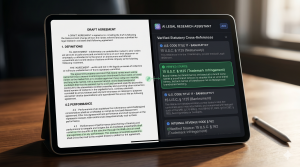
Law firm adoption of AI tools has accelerated rapidly. Industry surveys indicate that approximately 79 percent of law firms used some form of AI technology in 2025. The major legal technology platforms have all integrated generative AI capabilities.
- Thomson Reuters: Offers CoCounsel, an AI assistant built into Westlaw and Practical Law. The company reports that CoCounsel now serves one million professionals across 107 countries. They also offer Westlaw Precision AI with integrated research and drafting capabilities.
- LexisNexis: Has developed Lexis+ AI and, in June 2025, partnered with Harvey to become the first generative AI platform with full access to one of the two major proprietary U.S. legal databases.
- Microsoft Copilot: Available across the Microsoft 365 suite that most firms already use for document drafting and email.
- Harvey: Raised $760 million during 2025 at an $8 billion valuation, emerging as a leading standalone legal AI platform used by major law firms for contract analysis, research, and drafting.
Your Ethical Obligations
The ABA addressed lawyers’ use of generative AI directly in Formal Opinion 512, issued July 29, 2024. The opinion applies existing Model Rules of Professional Conduct to AI use and establishes several key obligations:
- Competence (Model Rule 1.1): You must understand the capabilities and limitations of any AI tool you use. This obligation is ongoing. As the technology evolves, your understanding must keep pace.
- Confidentiality (Model Rule 1.6): Before entering any client information into an AI tool, you must understand how the tool processes, stores, and potentially shares that data. Many AI tools use input data for model training unless the firm has negotiated an enterprise agreement with specific data protections. Entering privileged or confidential client information into a consumer-grade AI tool could waive privilege or breach your duty of confidentiality.
- Candor to the Tribunal (Model Rule 3.3): You must verify that every case, statute, and legal proposition generated by AI actually exists and accurately states the law before submitting it to a court. This is not optional. It is a fundamental obligation.
- Reasonable Fees (Model Rule 1.5): You cannot bill a client for time spent learning a general-purpose AI tool. If a client specifically requests the use of a particular AI tool, you may bill for time spent learning that specific tool. You also may not bill a client for eight hours of research if AI helped you complete the work in two.
- Supervisory Responsibilities (Model Rules 5.1 and 5.3): If you direct a paralegal, legal assistant, or junior associate to use AI, you are responsible for ensuring they use it competently and in compliance with ethical obligations.
Several states have issued their own AI guidance that supplements the ABA opinion. Texas Ethics Opinion 705, issued in February 2025, requires human oversight of all AI-generated work and specifically warns against submitting fabricated case citations. Florida Opinion 24-1 mandates that attorneys disclose AI use when it affects client billing. California’s State Bar approved proposed amendments to six Rules of Professional Conduct addressing AI in March 2026, and in May 2026 updated its Practical Guidance to address agentic AI. New York Formal Opinion 2025-6 addresses confidentiality and consent requirements when using AI to record and transcribe client meetings.
The Cautionary Tale Every New Lawyer Should Know
In June 2023, a federal judge in the Southern District of New York sanctioned attorneys Steven Schwartz and Peter LoDuca of the firm Levidow, Levidow & Oberman after they submitted a brief containing multiple case citations fabricated by ChatGPT. The cases did not exist. When the court asked for copies of the cited decisions, the attorneys submitted fabricated excerpts, also generated by ChatGPT, compounding the problem. Judge P. Kevin Castel imposed a $5,000 fine and referred the matter for additional review. The case, Mata v. Avianca, Inc., No. 22-cv-1461 (S.D.N.Y. 2023), became an immediate cautionary example cited by courts and bar associations nationwide.
The lesson is not that AI is too dangerous to use. The lesson is that AI output requires the same verification you would apply to work produced by anyone else. You would not file a brief drafted by a first-year law student without reading every case cited and confirming it says what the student claims it says. Apply the same standard to AI output. Every time.
Practical Advice for Using AI Responsibly
Use AI for tasks where it adds genuine value and where you can verify the output efficiently. AI tools are useful for generating first drafts of routine documents, summarizing lengthy depositions or document productions, identifying relevant search terms and research starting points, organizing and categorizing large volumes of discovery, and drafting initial outlines for briefs and memos.
Do not use AI as a substitute for your own legal judgment. AI cannot evaluate whether a legal strategy is wise. It cannot assess witness credibility. It cannot weigh the practical implications of a legal position for your specific client. And it cannot reliably distinguish between binding authority and persuasive authority in your jurisdiction.
Never submit AI-generated legal citations without independently verifying each one in the original source. Stanford research published in 2025 by Stanford CodeX found that Westlaw’s AI tools produced inaccurate results (hallucinations) approximately 33 percent of the time, Lexis+ AI approximately 17 percent, and standalone GPT-4 approximately 43 percent. These error rates make independent verification essential, not optional.
When you use AI on a client matter, be transparent. Tell your supervising attorney. Follow your firm’s AI usage policy. If your firm does not have a written AI policy, ask about one. Documenting your AI use and verification process protects you and the client.
Finally, invest in AI fluency as a career skill. The lawyers who will thrive over the next decade are those who learn to use AI tools effectively while maintaining the analytical rigor, factual precision, and professional judgment that AI cannot replace. Take CLE courses on legal technology. Experiment with your firm’s approved AI tools on non-sensitive matters. Read the ABA and state bar guidance. Understanding AI is now part of your obligation of competence under Model Rule 1.1, and the lawyers who develop this skill early will have a significant advantage.
The Bar Exam Is Changing: What Is the NextGen Redesign?
If you are preparing for the bar exam in 2026 or later, be aware that the exam itself is undergoing its most significant redesign in decades. The National Conference of Bar Examiners (NCBE) launched the NextGen Uniform Bar Examination (NextGen UBE) in July 2026, starting with ten jurisdictions including Connecticut, Idaho, Maryland, Missouri, Oregon, and Washington. Fifty jurisdictions have announced plans to adopt the exam between July 2026 and July 2028.
The NextGen UBE replaces the traditional Multistate Bar Examination (MBE), Multistate Essay Examination (MEE), and Multistate Performance Test (MPT) with an integrated format. It emphasizes practical legal skills, including legal research, client counseling, and negotiation, over memorization of black-letter law. If your jurisdiction is transitioning to the NextGen format, confirm the timeline with your state bar and adjust your preparation accordingly.
The Market You Are Entering: What Are the Realities of the 2026 Hiring Landscape?
The legal employment market for the Class of 2024 set a record, with an overall employment rate of 93.4 percent, the highest NALP has recorded. First-year associate salaries at major firms following the Cravath scale start at $225,000, with total compensation approaching $250,000 when bonuses are included. At the top of the scale, eighth-year associates earn $435,000 in base salary.
These numbers reflect the large-firm segment of the market. Compensation varies significantly by firm size, geography, and practice area. Smaller firms often pay between $60,000 and $100,000 for entry-level associates. Government and public interest positions typically pay less but may offer loan repayment assistance programs.
The hiring market, while strong recently, shows signs of tightening. Lateral hiring grew 16 percent in 2025, but many firms reduced their 2024 and 2025 summer associate class sizes. The contraction in federal hiring in early 2025, following the rescission of government job offers, pushed additional candidates into the private sector and increased competition for available positions.
Remote and hybrid work arrangements remain common in the post-pandemic legal market, but expectations vary widely by firm and practice group. Litigation practices that require frequent court appearances and in-person depositions tend to expect more office presence than transactional practices. Clarify your firm’s expectations during onboarding rather than assuming flexibility.
Frequently Asked Questions
How do I build trust with senior attorneys as a new lawyer?
Trust is built through consistent, reliable work product. Deliver complete, thoroughly researched, and carefully edited work on every assignment. Flag adverse authority rather than hiding it. Meet deadlines or communicate early when you cannot. Over time, partners will associate your name with dependability and begin assigning you higher-responsibility work.
What is the biggest mistake new lawyers make with legal research?
Starting with keyword searches rather than building a foundation through secondary sources and topical indexes. Keyword searching is essential for completing research but unreliable as a starting method because it depends on matching the exact terms courts used, which varies widely across jurisdictions and over time.
How many billable hours should I expect to work as a new associate?
Requirements vary by firm size and market. Large firms typically require between 1,800 and 2,200 hours annually. Smaller firms often set targets between 1,500 and 1,800 hours. Remember that billable hours represent only a portion of your total working time. For every billable hour, expect to spend additional time on administrative tasks, professional development, and firm activities that are not billable.
Can I use AI tools like ChatGPT for legal research?
You can use AI tools, but with significant guardrails. Never rely on AI-generated case citations without verifying each one independently in the original source. Follow your firm’s AI policy and the ethical guidance from the ABA Formal Opinion 512 and your state bar. Use AI to supplement your research, not to replace the structured research methodology that produces reliable results.
What should I do if a supervising attorney gives me a vague assignment?
Ask clarifying questions immediately. You are not imposing on the attorney by seeking clarity. You are ensuring that you can deliver useful work. Ask about the factual context, the specific legal question, the deadline, the intended audience for your work product, and how your assignment fits into the larger case or matter.
How is the bar exam changing in 2026?
The NCBE launched the NextGen Uniform Bar Examination in July 2026, starting in ten jurisdictions with fifty total jurisdictions planning adoption by July 2028. The new format integrates legal skills testing, including research and client counseling, into a unified exam that replaces the traditional MBE, MEE, and MPT. Check with your jurisdiction for specific adoption timelines.
What is ABA Formal Opinion 512?
Issued on July 29, 2024, ABA Formal Opinion 512 provides the first comprehensive ethical framework for lawyers using generative AI tools. It addresses competence, confidentiality, communication with clients, candor toward tribunals, supervisory responsibilities, and reasonable fees in the context of AI use. While the ABA Model Rules are not directly binding, most state rules closely track them, and Opinion 512 has been widely influential.
Connect with the Law Offices of Colby Lewis
Colby Lewis is the managing partner of The Law Offices of Colby Lewis, a Houston-based firm practicing personal injury, commercial litigation, and insurance bad faith law across Texas. Contact the firm at (713) 929-9624.
