
Short answer: Brain injuries in a car crash aren’t mainly caused by your head hitting something. They’re caused by your brain twisting and stretching inside your skull when your head accelerates and rotates. That’s why a low-speed rear-end collision can still injure your brain, and why a standard MRI or CT scan can come back “normal” while you’re living with real, lasting symptoms.
If you were in a wreck and you’re dealing with headaches, brain fog, memory problems, dizziness, or mood changes, this article explains what’s actually happening inside your head, why the insurance company’s “minor impact” argument is weak, and what it takes to prove a brain injury.
Key takeaways
- The brain is soft, incompressible tissue that deforms when your head moves suddenly. The damage comes from that deformation, not just from impact.
- Rotational (twisting) motion of the head is the primary driver of diffuse brain injury. One study found rotational acceleration contributed to more than 80% of brain strain in crash tests.
- In a rear-end crash, your head can accelerate 2 to 4 times faster than the vehicle itself. Speed of the cars does not equal force on the brain.
- Many traumatic brain injuries are “invisible” on a standard MRI or CT because the damage happens at a microscopic scale. Specialized imaging like DTI can reveal what routine scans miss.
- Age, sex, body size, and pre-existing conditions change how much injury a given crash causes. Two people in the same wreck can have very different outcomes.
What does “biomechanics” mean in a car accident case?
Biomechanics is the science of how physical forces act on the human body. In an injury case, a biomechanical analysis does four things:
- Explains what physically happened in the collision.
- Connects the forces of the crash to the specific injuries.
- Determines whether the collision was sufficient to cause injury.
- Identifies the individual risk factors that made injury more likely.
This matters because insurance companies love to argue that a crash “wasn’t bad enough” to hurt anyone. Biomechanics is how you answer that argument with physics instead of opinion.
Why does the brain get injured even without a direct blow to the head?
 Because of what the brain is made of. Brain tissue has a specific set of mechanical properties that make it vulnerable to sudden movement:
- Incompressible. It strongly resists being squeezed, so force passes through it rather than being absorbed.
- Deformable. It easily changes shape. It behaves more like gelatin than like a solid.
- Heterogeneous and anisotropic. Different parts of the brain, and even different directions within the same tissue, have different strengths. That creates internal stress points when the brain moves.
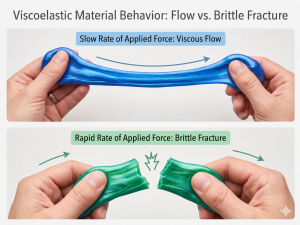
- Viscoelastic. The brain’s response depends on how fast the force is applied. Slow movement is tolerated. A rapid jolt is not.
That last point is the key. Apply force to the brain slowly and it flows and adapts. Apply the same force in a fraction of a second, and the tissue can’t keep up, so it stretches and tears at the cellular level. A car crash applies force in milliseconds.
What actually injures the brain in a crash: rotation, not just impact
The single most important concept for a car-accident brain injury is rotational (angular) acceleration, the twisting of the head.
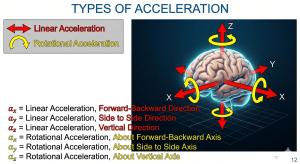 When your head is whipped and rotated, the brain inside lags behind and twists against itself. That twisting stretches the long nerve fibers (axons) that connect different regions of the brain. This is called diffuse axonal injury (DAI), and it’s one of the most serious and most under-diagnosed brain injuries.
The research is direct on this point:
- “Diffuse brain injuries are the consequence of distortion of the brain.” (Gennarelli, 1998)
- “Evidence points to rotational acceleration as the primary mechanism for the production of diffuse brain injuries.” (Gennarelli et al., 1998)
- “Rotational accelerations contributed to more than 80% of the brain strain.” (Zhang et al., 2006)
In plain terms: it’s the spin, not just the hit, that does the damage. You do not need to strike your head on anything to suffer a brain injury. The whipping motion alone can be enough.
Can a low-speed or “minor” crash really cause a brain injury?
 Yes. This is where insurance companies are most often wrong, and where the physics matters most.
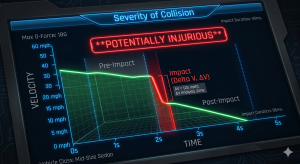
In a rear-end impact, your head does not move at the same speed as your car. Because of the “whip effect,” your head accelerates 2 to 4 times faster than the vehicle (West et al., 1993; Tanner et al., 1997). A modest change in vehicle speed can translate into a violent acceleration of your head and neck.
The force on your body comes from Newton’s Second Law: Force = mass × acceleration. Injury severity tracks two things: how much the tissue is deformed, and how much of it is affected. Neither one is the same as how fast the cars were going or how much the bumpers were dented.
The honest part: not every fender-bender causes a brain injury. Whether a specific crash hurt a specific person depends on the forces involved and that person’s individual risk factors. That’s exactly what a biomechanical analysis is built to evaluate, and it’s why “the cars were barely damaged” is an argument about sheet metal, not about your brain.
Why is my MRI “normal” if I have brain injury symptoms?
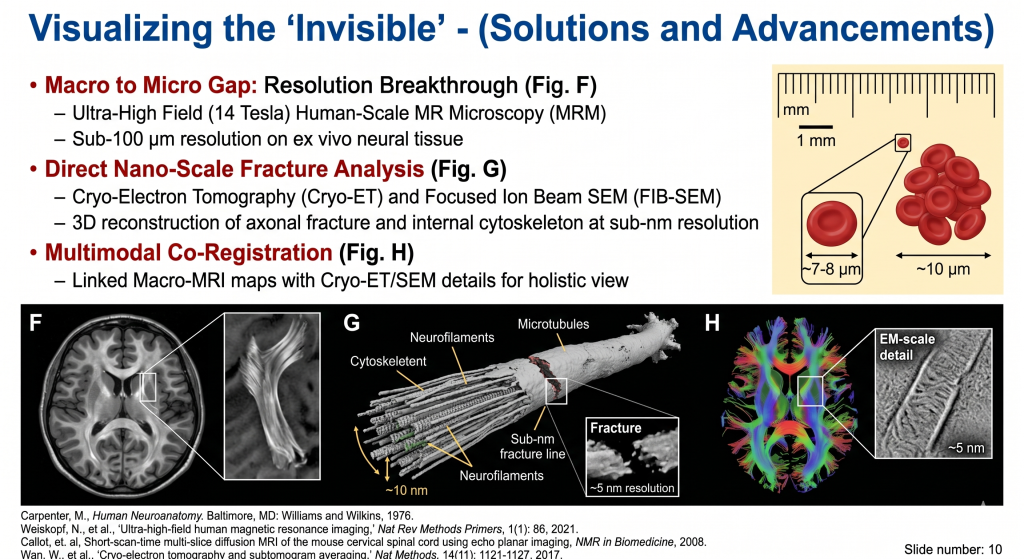 Because most routine imaging can’t see the kind of damage a crash causes. Diffuse axonal injury happens at a scale far smaller than a standard MRI or CT scan can resolve.
Brain damage occurs across three size scales:
- Macro scale (millimeters). This is the limit of what standard MRI can detect.
- Micro scale (microns, a thousandth of a millimeter). This is the level of individual cells. Visible only with specialized microscopy, often only on autopsy.
- Nano scale (billionths of a meter). This is the level of the individual axon fibers, visible only with an electron microscope.
A torn axon is invisible to the machine that took your scan. That’s why doctors call mild TBI an “invisible injury.” A normal CT or MRI does not mean your brain is fine. It often just means the injury is below the resolution of that test.
Specialized imaging can close the gap. Diffusion Tensor Imaging (DTI) and Susceptibility Weighted Imaging (SWI) are more sensitive to the microscopic, diffuse damage that routine scans miss. If you have persistent symptoms and a “clean” scan, that mismatch is a reason to dig deeper, not to assume nothing is wrong.
Why do two people in the same crash have different injuries?
 Because the human body isn’t standardized. The same collision can produce very different injuries depending on individual risk factors:
- Age. Bone and tissue tolerance drops significantly with age. Research has found the load required to cause failure can drop by roughly half in older individuals (Yoganandan, 1989). Osteoporosis and spine degeneration change how the body responds to trauma (Nahum, 1994).
- Body size and seated position. How you were sitting and how your body was positioned at the moment of impact affects what gets injured (Walz, 2000; West, 1993).
- Pre-existing conditions. Prior injuries or disease can make a person more vulnerable. In Texas, this connects to the “eggshell plaintiff” rule: a defendant takes the victim as they find them. Being more fragile doesn’t reduce their responsibility for the harm they caused.
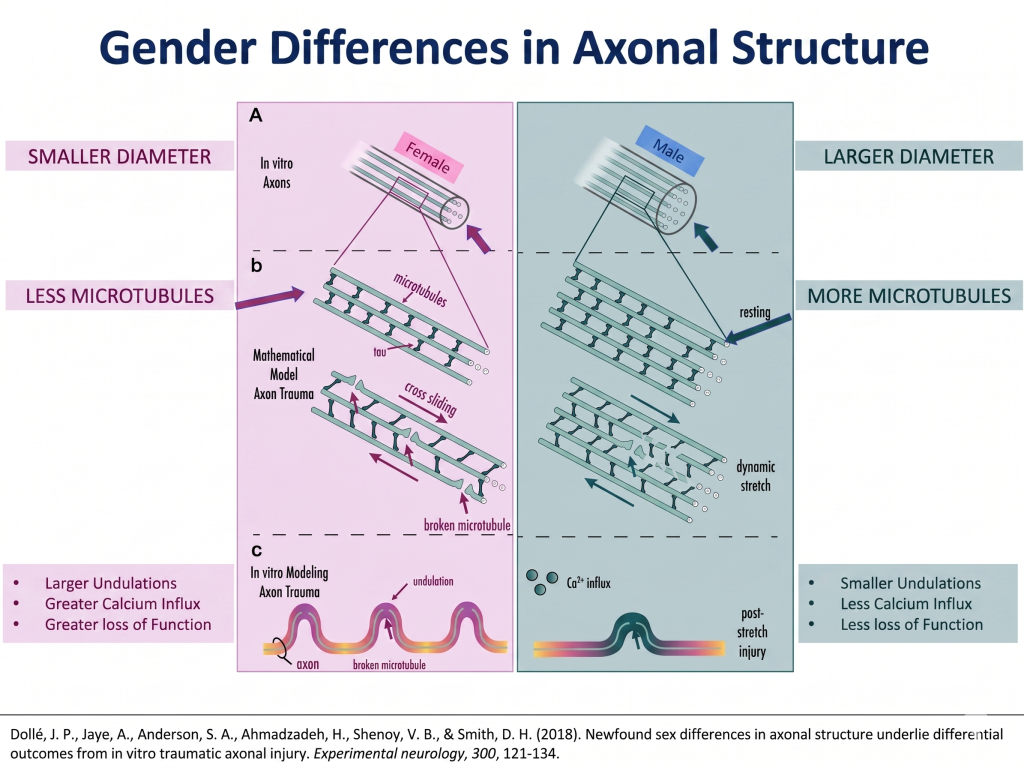
- Sex. Emerging research shows real biological differences. In rear-impact testing, women experienced meaningfully higher head acceleration than men under the same conditions (Hell et al., 2002; Ziejewski & Yliniemi, 2009). At the cellular level, female axons tend to be smaller with structural differences associated with greater loss of function after injury (Dollé et al., 2018).
The takeaway: “a normal person wouldn’t be hurt by this” is not a defense. You are not a crash-test dummy, and the law doesn’t require you to be average.
How do you prove a brain injury from a car accident?
 Proving a TBI usually combines several layers of evidence:
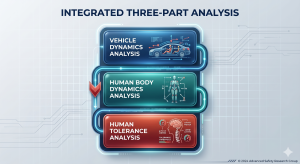
- The biomechanics. An analysis of vehicle dynamics, human body dynamics, and human tolerance to show the crash produced forces capable of causing the injury.
- The medical record. Consistent documentation of symptoms from as close to the crash as possible. Headaches, cognitive problems, sleep and mood changes, dizziness.
- Specialized imaging and testing. DTI/SWI imaging and neuropsychological testing that can detect deficits a standard scan misses.
- The human story. Testimony from family, coworkers, and friends about how the person changed after the wreck. Brain injuries often show up first in behavior, not on a film.
No single piece does it alone. The case is strongest when the physics, the medicine, and the lived experience all point the same direction.
Talk to a Houston brain injury lawyer
If you or someone you love is dealing with the aftermath of a head injury from a car crash, don’t let an insurance adjuster tell you a “minor” wreck couldn’t have hurt you. The science says otherwise, and so does our experience handling these cases.
Our Houston brain injury lawyer handles serious injury and traumatic brain injury cases in Houston and across Texas. Consultations are free, and you owe us nothing unless we recover for you.
Call us or request a free case review today.
Frequently asked questions
Can a low-speed car accident cause a traumatic brain injury?
Yes. In a rear-end crash, your head can accelerate 2 to 4 times faster than the vehicle, so even a low-speed impact can generate enough force to injure the brain. The amount of vehicle damage does not determine whether your brain was hurt.
Why is my MRI normal if I have brain injury symptoms?
Diffuse axonal injury occurs at a microscopic scale that standard MRI and CT scans cannot resolve. A normal scan often means the injury is below the resolution of the test, not that there’s no injury. Specialized imaging like DTI or SWI can detect damage routine scans miss.
What is diffuse axonal injury?
Diffuse axonal injury (DAI) is widespread damage to the brain’s nerve fibers caused when the head rotates rapidly and the brain twists inside the skull, stretching and tearing axons. It’s a common and serious result of car crashes and is often invisible on routine imaging.
What causes brain injury in a car crash, the impact or the motion?
Primarily the motion. Rotational (twisting) acceleration of the head is the leading cause of diffuse brain injury. One study attributed more than 80% of brain strain to rotational acceleration. You don’t have to hit your head to suffer a brain injury.
Does a pre-existing condition hurt my injury claim?
No. Under Texas’s “eggshell plaintiff” rule, a defendant takes the victim as they find them. If a pre-existing condition made you more vulnerable to injury, that does not reduce the at-fault party’s responsibility for the harm they caused.
How do you prove a brain injury after a car accident?
By combining biomechanical analysis of the crash forces, consistent medical documentation, specialized imaging and neuropsychological testing, and testimony from people who can describe how you changed after the wreck. Together these show both that the crash could cause the injury and that it did.
Sources
This article draws on established peer-reviewed biomechanics research, including work presented by Mariusz Ziejewski, Ph.D. (Professor Emeritus, North Dakota State University; Director, Impact Biomechanics Laboratory) at the 2023 TBI Med-Legal Conference. Key studies referenced:
- Gennarelli, T., Thibault, L.E., & Graham, D.I. (1998). “Diffuse Axonal Injury: An Important Form of Traumatic Brain Damage.” The Neuroscientist, 4(3).
- Zhang, J., Yoganandan, N., Pintar, F.A., & Gennarelli, T.A. (2006). “Brain strains in vehicle impact tests.” Annual Proceedings, Association for the Advancement of Automotive Medicine, Vol. 50.
- West, D.H., et al. (1993); Tanner, et al. (1997). Head acceleration magnification in rear-end impacts.
- Nahum, A. (1994); Walz (2000); Yoganandan, N. (1989). Age, body size, and pre-existing conditions in injury biomechanics.
- Hell, W., Schick, S., & Langwieder, K. (2002). “Biomechanics of Cervical Spine Injuries in Rear End Car Impacts.” Traffic Injury Prevention.
- Ziejewski, M. & Yliniemi, E.M. (2009). “Prediction of Head Acceleration and Neck Loading in Vertical Impact.”
- Dollé, J.P., et al. (2018). “Newfound sex differences in axonal structure underlie differential outcomes from in vitro traumatic axonal injury.” Experimental Neurology, 300.
Disclaimer: This article is for general information only and is not legal or medical advice. It does not create an attorney-client relationship. Every case is different and past results do not guarantee a future outcome. If you think you have a brain injury, seek medical care. For advice about your specific situation, contact a licensed attorney. The Law Offices of Colby Lewis is responsible for the content of this communication. Principal office: Houston, Texas.
