
New Rules, New Risks, and What Victims Must Know Now
Reviewed by Colby Lewis, Houston Accident Lawyer | Texas Super Lawyer (10+ Consecutive Years) | Top 100 Houston Lawyer | AV Preeminent Rated
Last Updated: April 2026
If you were hit by a commercial truck in Houston, Texas, you may have claims against the driver, the trucking company, and the freight broker. Texas law allows recovery for medical bills, lost wages, pain and suffering, and in cases of gross negligence, punitive damages. Time-sensitive evidence and new 2026 procedural rules make immediate legal action critical.
The landscape for commercial vehicle accident litigation in Texas changed dramatically in early 2026. The Texas Supreme Court completely rewrote the summary judgment rule. The FMCSA forced a digital overhaul of how trucking companies verify driver medical fitness. And federal regulators are moving to add fentanyl to mandatory drug testing panels for commercial drivers.
These are not abstract legal developments. They directly affect how quickly your case must be prepared, what evidence is available, and how much leverage you have against the trucking company and its insurer.
In this guide, our Houston accident attorney breaks down every critical shift, what it means for Houston accident victims, and the specific steps required to protect a claim in this new environment. No filler. No platitudes. Facts, deadlines, and the litigation tools we use to win.
1. The New Texas Summary Judgment Rules (Rule 166a), Effective March 1, 2026
Texas Rule of Civil Procedure 166a was completely rewritten effective March 1, 2026. Responses to summary judgment motions are now due 21 days after filing. Courts must set a hearing within 60 days and issue a written ruling within 90 days of the hearing. These compressed deadlines make early and aggressive case preparation mandatory for every personal injury plaintiff.
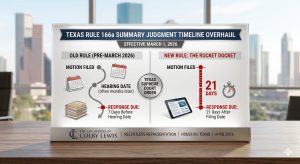
Top 100 Houston Lawyer Colby Lewis visualizes the impact of the March 1, 2026, Rule 166a rewrite, comparing the new 21-day ‘rocket docket’ deadlines to the previous, flexible system.
On February 27, 2026, the Texas Supreme Court signed Misc. Docket No. 26-9012, finalizing the most significant overhaul of Texas summary judgment practice in nearly three decades. The legislature mandated this rewrite through Senate Bill 293 and House Bill 16 during the 89th Legislative Session. The goal was to eliminate the common problem of summary judgment motions sitting on trial court dockets for months or years without a ruling.
What Changed: Old Rules vs. New Rules
Under the prior version of Rule 166a, response deadlines were tied to the hearing date. A motion had to be filed at least 21 days before the hearing, and responses were due at least 7 days before the hearing. Courts had no deadline for ruling. Motions could sit unresolved until the day of trial.
The new rule flips the entire timeline. Here is how the deadlines now work:
Day 0: Motion filed. The clock starts. The response deadline is now triggered by filing, not by the hearing date.
Day 21: Response due. The non-movant must file a response within 21 days after the motion is filed. This deadline can be extended by leave of court or agreement of the parties, but the default is firm. (Rule 166a(d)(1))
Day 28: Reply due. The movant’s reply is due within 7 days after the response is filed. The reply cannot raise new or independent grounds for summary judgment. It can only address arguments raised in the response. (Rule 166a(d)(2))
Day 35-60: Hearing window. The court cannot set a hearing or written submission date earlier than 35 days after filing. But the court must set the hearing within 60 days of filing. That 60-day window can be extended to 90 days for good cause, docket necessity, or with the movant’s agreement. (Rule 166a(g)(1))
90 days after hearing: Ruling deadline. The court must sign a written ruling, file it with the clerk, and provide it to the parties within 90 days after the hearing or submission date. (Rule 166a(i))
Why This Matters for Truck Accident Victims
Insurance defense teams now have a streamlined tool to test the strength of your case early. A no-evidence motion for summary judgment can be filed after adequate time for discovery, and it forces the plaintiff to produce evidence raising a genuine issue of material fact on every challenged element.
If your attorney has not already secured expert witnesses, completed key depositions, and obtained the trucking company’s safety records before a no-evidence motion lands, you are at risk of having your case dismissed before it ever reaches a jury.
There is one critical counterbalance for plaintiffs. Under Rule 166a(d)(3), if a no-evidence motion is filed before adequate discovery is complete, the non-movant can seek an extension or denial without prejudice. This mechanism matters. A skilled plaintiff’s attorney will use it aggressively to prevent premature dispositive motions.
Another practical effect noted by Segal McCambridge’s analysis: the 90-day ruling deadline may actually lead to more motions being denied, because courts under time pressure may deny motions they cannot fully evaluate. That creates a tactical consideration for both sides.
The bottom line: the new Rule 166a rewards firms that prepare cases from day one. Waiting is no longer a strategy. It is a liability.
2. FMCSA’s Digital Medical Certification Mandate (NRII)
The FMCSA’s National Registry II (NRII) rule replaced paper medical cards with electronic transmission of driver medical certifications to state motor vehicle records. Carriers must now verify driver medical fitness through the MVR, not paper certificates. Failures in this system create powerful evidence of carrier negligence in truck accident litigation.

Modern 18-wheelers utilize Level 4 telematics and AI dashcams, capturing highly perishable “digital smoking gun” evidence that must be secured immediately.
The Medical Examiner’s Certification Integration final rule, published by the Federal Motor Carrier Safety Administration (FMCSA) in 2015, went into full effect on June 23, 2025. The system had been delayed repeatedly over the prior decade due to technical problems and state-level implementation failures.
How NRII Works
Under NRII, certified medical examiners must electronically submit the results of a DOT physical examination to the FMCSA National Registry by midnight of the next calendar day following the exam. FMCSA then transmits those results to State Driver’s Licensing Agencies (SDLAs), which post the information to the driver’s Commercial Driver’s License Information System (CDLIS) motor vehicle record (MVR).
The MVR is now the official record of medical certification for CDL holders. Paper medical examiner certificates are no longer acceptable as proof of medical certification for CDL compliance in states that have implemented NRII.
The Transition Is Not Complete
Eight states had not implemented NRII as of the most recent FMCSA waiver issued December 30, 2025: Alaska, California, Kentucky, Louisiana, New Hampshire, New Jersey, New York, and Oklahoma.
Texas has implemented NRII. That means carriers operating out of Houston are subject to the full electronic verification requirements.
FMCSA issued a temporary waiver effective January 11, 2026 through April 10, 2026, allowing continued use of paper medical examiner certificates for up to 60 days after issuance. This waiver was the fourth extension since the rule went live in June 2025.
What This Means for Litigation
Under 49 CFR § 391.51, motor carriers must maintain a driver qualification file that includes verification of the driver’s medical certification. Under 49 CFR § 391.23, carriers must make certain inquiries and investigations before allowing a driver to operate a commercial motor vehicle.
In an NRII-compliant state like Texas, the carrier’s obligation is to check the driver’s MVR to confirm current medical certification before dispatching that driver. If the MVR shows “Not Certified” or reflects an expired or failed examination, and the carrier dispatches the driver anyway, that carrier has violated federal motor carrier safety regulations.
A regulatory violation of this kind supports several theories of liability: negligence per se (violation of a safety statute), negligent entrustment (entrusting a commercial vehicle to an unfit driver), and potentially gross negligence if the carrier was subjectively aware of the risk and dispatched the driver in conscious disregard of safety. Gross negligence in Texas requires proof of an “extreme degree of risk” and the defendant’s actual, subjective awareness of that risk.
At our firm, we pull the driver’s MVR and the carrier’s compliance history through FMCSA’s SAFER Web system on every commercial vehicle case. We cross-reference medical certification status, safety ratings, out-of-service rates, and inspection history.
3. Evidence Preservation: The First 48 Hours
After a commercial truck accident in Texas, critical digital evidence can be lost or overwritten within hours. Federal regulations require carriers to retain electronic logging device data for six months, but event data recorders, dashcam footage, and telematics buffers may have shorter retention windows. A spoliation letter from your attorney must be sent immediately to preserve all digital evidence.
Modern commercial trucks generate massive amounts of data. Electronic Logging Devices (ELDs), event data recorders (EDRs), forward-facing and driver-facing cameras, GPS telematics, and Advanced Driver Assistance Systems (ADAS) all produce evidence that can prove fault, speed, driver distraction, fatigue, and mechanical failure. The problem is that some of this data is perishable.
Federal Data Retention Requirements
ELD records: Under 49 CFR § 395.8, motor carriers must retain records of duty status (RODS) for six months. ELD-generated data falls within this requirement.
Supporting documents: Under 49 CFR § 395.22, supporting documents for RODS must also be retained for six months.
Driver qualification files: Under 49 CFR § 391.51, qualification files must be maintained for the duration of employment and for three years after.
What Is at Risk of Loss
Event Data Recorders (EDRs): The “black box” in a commercial truck records pre-crash data including speed, brake application, throttle position, and steering input. EDR data is stored in a limited memory buffer. If the truck is repaired and returned to service before the EDR is imaged by a forensic specialist, the pre-crash data may be overwritten by subsequent driving events.
Dashcam and driver-facing camera footage: Major telematics platforms used by commercial fleets, including Samsara, Motive (formerly KeepTruckin), and Lytx DriveCam, handle video retention differently. Some systems upload triggered events to cloud storage automatically. Others retain only a rolling buffer of recent footage that is overwritten on a continuous cycle. Without a preservation demand, non-event footage may be gone within days.
Post-Accident Drug and Alcohol Testing
Federal regulations require post-accident drug and alcohol testing under specific circumstances. Under 49 CFR § 382.303, the carrier must ensure that a controlled substance test is administered within 32 hours of the accident, and an alcohol test within 8 hours. If the carrier fails to administer the test within these windows, the carrier must document the reason.
The current DOT drug testing panel covers marijuana, cocaine, amphetamines, opioids (codeine, morphine, heroin, hydrocodone, hydromorphone, oxycodone, oxymorphone), and PCP. The U.S. Department of Transportation published a Notice of Proposed Rulemaking on September 2, 2025, proposing the addition of fentanyl and norfentanyl to both urine and oral fluid testing panels. Attorneys handling truck accident cases should request comprehensive toxicology panels that include synthetic opioids as part of the post-accident investigation regardless of the final rule’s status.
4. Freight Broker Liability in Texas
In Texas, the freight broker that hired a trucking company can be held liable if the broker negligently selected an unsafe carrier. Brokers are required to verify a carrier’s safety record, insurance, and operating authority before tendering freight. A negligent selection claim can provide access to additional insurance coverage beyond the carrier’s often-inadequate policy.
Many catastrophic truck accidents involve small carriers with minimal insurance. The FMCSA-required minimum financial responsibility for interstate motor carriers transporting non-hazardous property is $750,000 under 49 CFR § 387.9. For carriers of certain hazardous materials, the minimum is $1 million or $5 million depending on the commodity. A $750,000 policy does not cover the medical bills, lost wages, and future care costs of a catastrophic spinal cord injury, traumatic brain injury, or wrongful death.
How Freight Brokerage Creates Liability
Freight brokers arrange transportation of goods by connecting shippers with motor carriers. Brokers must register with FMCSA and maintain a $75,000 surety bond or trust fund under 49 CFR § 387.307. While brokers do not own or operate the trucks, they select the carriers to whom freight is tendered. That selection decision is the basis for liability.
Every motor carrier’s safety data, including crash history, inspection results, out-of-service rates, and safety ratings, is publicly available through FMCSA’s SAFER Web system. A broker that tenders freight to a carrier with an “Unsatisfactory” safety rating, a high out-of-service percentage, or a pattern of serious violations may be liable for negligent selection.
Brokers can and should verify that the carrier holds active operating authority and adequate insurance coverage through FMCSA’s Licensing and Insurance (L&I) system. Tendering freight to an uninsured or underinsured carrier is evidence of negligent selection.
The Federal Preemption Defense
The primary defense brokers assert is federal preemption under 49 U.S.C. § 14501(b)(1), the Federal Aviation Administration Authorization Act (FAAAA). This statute preempts state laws “related to a price, route, or service of any broker.” Brokers have argued that negligence claims arising from carrier selection are “related to” their “service” and therefore preempted.
The federal courts are divided on this issue. Practitioners should research the current status of this circuit split when evaluating broker liability theories. The viability of a negligent selection claim against a broker may depend on which federal circuit, or which Texas state court, hears the case.
By investigating the entire supply chain, from shipper to broker to carrier to driver, we identify every available source of insurance coverage. In cases involving catastrophic injuries, the difference between a $750,000 carrier policy and a multi-million-dollar broker policy is the difference between an inadequate settlement and full compensation.
5. Houston’s High-Risk Commercial Vehicle Corridors
Harris County, Texas, contains some of the highest-volume commercial vehicle corridors in the United States. The intersection of freight traffic from the Port of Houston, the petrochemical corridor along SH-225, and the regional highway network creates concentrated crash risk zones that require targeted investigation in every commercial vehicle accident case.
Houston is the largest city in the United States without zoning laws, the home of the Port of Houston (the largest port in the U.S. by foreign waterborne tonnage), and a hub for petrochemical manufacturing, oil and gas logistics, and interstate freight movement. These factors combine to produce an extraordinarily high density of commercial vehicle traffic on highways that were not designed for the volume they now carry.
Key Corridors and Risk Factors
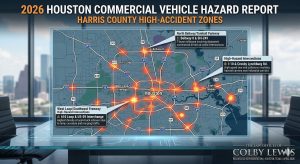
Attorney Colby Lewis analyzes the 2026 high-hazard zones for commercial vehicle and 18-wheeler accidents across Harris County.
The following corridors warrant heightened attention in any Houston-area commercial vehicle accident investigation. Crash data for these locations can be verified through the TxDOT Crash Records Information System (CRIS), which is the authoritative source for Texas crash data.
610 West Loop at US-59/I-69 Interchange. This interchange handles merging traffic from two of Houston’s busiest highways. The complex geometry requires lane changes across multiple levels. Commercial vehicles navigating this interchange face blind-spot merging conditions that passenger vehicles do not.
I-10 East (Crosby Lynchburg Road area). The I-10 East corridor near the Houston Ship Channel serves as a primary artery for port logistics. High concentrations of loaded 18-wheelers, tanker trucks, and container chassis create elevated rear-end collision risk, particularly during shift changes at petrochemical facilities.
SH-225 (Pasadena to La Porte industrial corridor). This is the spine of the Houston petrochemical belt. The mix of heavy industrial truck traffic, hazmat carriers, and commuter vehicles on a highway with at-grade intersections and limited shoulders creates persistent hazard conditions.
Beltway 8 at SH-249. Rapid development in the Tomball and northwest Houston corridors has outpaced infrastructure investment. Commercial traffic volumes have increased while road geometry has not been updated.
I-45 North (Woodlands freight corridor). Interstate freight traffic between Houston and Dallas shares this corridor with dense suburban commuter traffic. Speed differentials between fully loaded commercial vehicles and passenger cars are a persistent contributing factor.
Port of Houston truck routes (SH-146, Clinton Drive, SH-134). These routes carry container chassis and overweight loads to and from port terminals. Road surface deterioration, limited lighting, and narrow lane widths compound the risk.
I-10 West (Katy Freeway expansion zones). Active and recently completed TxDOT construction projects along the Katy Freeway corridor create lane shifts, narrowed shoulders, and temporary traffic patterns that increase crash risk for commercial vehicles.
Why Location Matters in Litigation
In every Houston truck accident case, we investigate the specific conditions of the crash location: road design, sight lines, signage, lighting, construction zone status, and traffic volume. When infrastructure deficiencies contribute to a crash, the governmental entity responsible for road design or maintenance may bear liability under the Texas Tort Claims Act, subject to its notice and immunity provisions.
6. ADAS, Telematics, and Digital Evidence in Truck Accident Litigation
Modern commercial trucks are equipped with Advanced Driver Assistance Systems (ADAS) and telematics platforms that generate critical digital evidence. Lane-keep assist logs, automatic emergency braking data, and driver-facing camera footage can prove fault, distraction, and mechanical failure. Obtaining and interpreting this evidence requires specialized discovery and expert analysis.
Deployed ADAS Systems in Commercial Fleets
Automatic Emergency Braking (AEB). Systems like Bendix Wingman Fusion and Detroit Assurance (standard on Freightliner/Daimler trucks) use radar and camera input to detect imminent collisions and apply brakes automatically if the driver fails to respond. These systems generate logs that record whether the system detected an obstacle, whether it issued a warning, and whether it applied braking force.
Lane Departure Warning and Lane-Keep Assist. These systems monitor lane position and either alert the driver or actively steer the vehicle back into the lane. The data logs record every intervention and every warning.
Adaptive Cruise Control. Maintains a set following distance from the vehicle ahead. The system logs speed adjustments, following distance, and driver override events.
Driver-facing cameras. Platforms like Lytx DriveCam, Samsara, and Motive use AI-powered cameras that detect driver distraction, drowsiness, and cell phone use. Triggered events are uploaded to cloud storage with timestamps.
A Note on Autonomous Trucking
SAE Level 4 autonomous commercial trucking (where the vehicle handles all driving tasks within a defined operational domain without human intervention) is being tested in limited corridors by companies including Aurora Innovation and others. As of this writing, Level 4 autonomous trucks are not in widespread commercial fleet deployment. The ADAS systems described above are the deployed reality.
How to Obtain This Evidence in Texas Litigation
Digital evidence from telematics and ADAS systems is discoverable under the Texas Rules of Civil Procedure. TRCP 196.4 governs the production of electronic data. TRCP 192.4 establishes the proportionality framework. Expert testimony on ADAS and telematics evidence must satisfy the reliability standards established by the Texas Supreme Court in E.I. du Pont de Nemours & Co. v. Robinson, 923 S.W.2d 549 (Tex. 1995).
7. What Determines the Value of a Houston Truck Accident Case
The value of a Texas truck accident case is determined by the severity of the injury, the strength of the liability evidence, the number of defendants and available insurance coverage, and whether the conduct supports a claim for exemplary (punitive) damages. There is no reliable formula. Every case turns on its facts.
We do not publish “average settlement ranges” because they are misleading. A minor soft-tissue injury and a catastrophic traumatic brain injury are both “truck accident cases,” and quoting an average of the two helps no one. What we can explain is the framework that drives case value in Texas.
Categories of Damages
Economic damages include past and future medical expenses, lost earnings, loss of earning capacity, and other out-of-pocket costs directly caused by the injury.
Non-economic damages include physical pain, mental anguish, disfigurement, physical impairment, and loss of consortium. Texas does not cap non-economic damages in personal injury cases (unlike medical malpractice cases, which are capped under Tex. Civ. Prac. & Rem. Code Chapter 74).
Exemplary (punitive) damages are available under Tex. Civ. Prac. & Rem. Code § 41.003 when the defendant’s conduct involves fraud, malice, or gross negligence. The standard requires clear and convincing evidence. Exemplary damages are capped under § 41.008 at the greater of: (a) $200,000, or (b) two times the amount of economic damages plus an amount equal to non-economic damages up to $750,000. There is no cap when the underlying tort is a specific felony offense.
Factors That Increase Case Value
Multiple defendants. Establishing liability against the driver, the carrier, and the freight broker multiplies the available insurance coverage.
Catastrophic injury. Traumatic brain injury, spinal cord injury, amputation, severe burns, and wrongful death cases command significantly higher valuations because the future medical and economic costs are substantial and provable.
Gross negligence. A viable gross negligence claim opens the door to exemplary damages, increases settlement leverage, and may pierce policy limits.
Regulatory violations. Documented FMCSR violations (hours-of-service falsification, failed drug tests, expired medical certification, maintenance deficiencies) strengthen both liability and punitive damage theories.
Strong digital evidence. EDR data showing excessive speed, ADAS logs showing failure to brake, and dashcam footage showing driver distraction create compelling trial exhibits that drive settlement value upward.
8. Frequently Asked Questions
How long do I have to file a truck accident lawsuit in Texas?
The statute of limitations for personal injury in Texas is two years from the date of the accident under Tex. Civ. Prac. & Rem. Code § 16.003. For wrongful death, the two-year period begins on the date of death. Missing this deadline permanently bars the claim. However, critical evidence can be lost within days or weeks, so retaining an attorney immediately is essential.
Can I sue the trucking company, not just the driver?
Yes. Under the doctrine of respondeat superior, an employer is liable for the negligent acts of its employees committed within the scope of employment. The carrier may also be directly liable for negligent hiring, negligent entrustment, negligent supervision, and negligent maintenance. Under 49 CFR § 390.5, a motor carrier is defined as the entity responsible for the operation of commercial motor vehicles.
What is the new Rule 166a and how does it affect my case?
Texas Rule of Civil Procedure 166a was completely rewritten effective March 1, 2026. It imposes compressed deadlines for summary judgment practice. Your attorney must be prepared to respond to dispositive motions within 21 days of filing and must have expert and fact witness evidence ready early in the case.
What is NRII and why does it matter for my truck accident case?
NRII is the FMCSA’s National Registry II system that requires electronic verification of commercial driver medical certifications through the motor vehicle record. If the carrier failed to verify the driver’s medical fitness before dispatch, that is evidence of a federal regulatory violation.
How much is my truck accident case worth?
There is no honest way to answer this without reviewing the specific facts of your case. Value depends on injury severity, available insurance coverage, number of liable parties, and whether gross negligence supports exemplary damages.
What evidence should I preserve after a truck accident?
Preserve everything: photos of the scene, your vehicle, and your injuries. Get the names and contact information of witnesses. Do not give recorded statements to any insurance company before speaking with an attorney. Your attorney should immediately send a spoliation letter to preserve the trucking company’s digital evidence, including ELD data, dashcam footage, EDR data, and dispatch records.
Can I sue the freight broker?
Potentially. If the broker negligently selected an unsafe carrier, a negligent selection claim may be viable. This requires investigating the carrier’s FMCSA safety record, the broker’s selection process, and the contractual relationship. Federal preemption defenses exist but are not universally successful.
9. Why Results Matter: The Law Offices of Colby Lewis

Relentless Representation from the heart of Houston’s legal district: The Law Offices of Colby Lewis, 815 Walker St., Suite 452.
This is not a firm that processes cases. This is a firm that litigates them.
Over $200 million recovered for clients across personal injury, premises liability, commercial litigation, and insurance bad faith cases over 20+ years of practice.
Texas Super Lawyer, 10+ consecutive years. Peer-reviewed recognition placing Colby Lewis in the top tier of the Texas plaintiffs’ bar.
AV Preeminent rated by Martindale-Hubbell. The highest possible rating for legal ability and ethical standards.
Best Lawyers in America recognition for Construction Law.
20+ years of litigation experience, including prior defense-side work for major insurance carriers. We know how the other side thinks, because we used to be the other side. That perspective informs every case strategy we build.
We handle truck accident and commercial vehicle cases on a contingency fee basis. You pay nothing unless we recover for you.
The clock is running. The new Rule 166a deadlines are already in effect. Digital evidence from the truck’s telematics and cameras is at risk of being overwritten. The carrier’s insurer has already assigned a team to minimize your claim.
Call Colby Lewis today for a free, no-obligation consultation.
(866) 265-2948
815 Walker St., Suite 452 | Houston, TX 77002
This guide is provided for informational purposes and does not constitute legal advice. Every case is different. Contact an attorney to discuss the specific facts of your situation.
Colby Lewis is the Managing Partner of The Law Offices of Colby Lewis, PLLC (Texas Bar No. 24050928). He practices exclusively on the plaintiff’s side of personal injury, commercial litigation, and insurance disputes.
