
Reviewed by Colby Lewis, Houston Accident Lawyer
Bottom Line: When you hire a Texas Bar College Fellow as your personal injury attorney, you are hiring a lawyer who has voluntarily completed more than double the state-required continuing legal education every year for over a decade. 2026 marks my 14th consecutive year maintaining this distinction. That means I have already mastered the complete rewrite of Texas summary judgment rules that took effect March 1, and I am prepared to counter the tort reform legislation insurance companies will push in the next session. Fourteen years of this commitment is not a habit. It is a discipline that protects your case.
Most people who call my office after a car wreck, a fall on someone else’s property, or a construction site injury don’t ask how many hours of legal education their lawyer completed last year. I understand that. You’re in pain. You need help. You want to know if I can get you paid.
But here’s why it should matter to you: the law changed this year. Significantly. And the difference between the lawyer who learned those changes the day they dropped and the lawyer who is still operating under rules from 1997 could be the difference between your case going to a jury and your case being thrown out on a technicality.
This year marks my 14th consecutive year as a member of the Texas Bar College. That is 14 straight years of completing at least 30 hours of advanced legal education annually, more than double what the state requires. It is a streak I have never broken, and I never will. Let me explain what it means and why it matters to you.
What Is the Texas Bar College, and What Is a Fellow?
The Texas Bar College is an honorary society established by order of the Texas Supreme Court on December 14, 1981. It is the only organization in the United States created specifically to recognize attorneys who pursue excellence through voluntary continuing legal education.
Every Texas lawyer must complete 15 hours of CLE per year. That is the minimum the state will accept before letting you keep your license. To earn and maintain membership in the Texas Bar College, I must complete at least 30 hours per year. That is not a one-time requirement. It resets every year. Fall below the threshold, and you lose your standing.
The Texas Bar College also grants a special designation of “Fellow” to members who maintain more than 10 consecutive years of membership. I have held that Fellow status for four years running. Across the entire State of Texas, relatively few attorneys carry this distinction. It represents not just a single year of extra effort, but a sustained, verified commitment to legal education stretching back to 2013.
As the Texas Bar College states, its purposes include recognizing lawyers who maintain and enhance their professional skills and the quality of their service to the public by significant voluntary participation in continuing legal education, and promoting high ethical standards and improved training for all legal professionals.
This is not a vanity credential. It is 14 years of proof, verified by the State Bar, that I invest real time into becoming a better lawyer for my clients.
What Changed in 2026: The New Texas Summary Judgment Rules
If there was ever a year that proved why this commitment matters, it is this one.
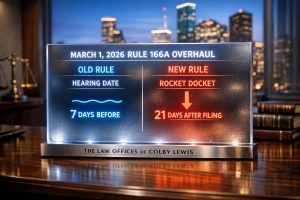 On March 1, 2026, the Texas Supreme Court’s complete rewrite of Texas Rule of Civil Procedure 166a went into effect. This is the rule that controls summary judgment, the procedural motion insurance defense lawyers use to try to get your case dismissed before you ever see a jury.
The old Rule 166a had been in place for decades. The new rule, driven by SB 293 and HB 16 from the 89th Legislature, changes the game in several critical ways.
Deadlines Are Now Anchored to the Filing Date
Under the old system, your response to a summary judgment motion was due 7 days before the hearing. That gave plaintiff’s attorneys time to prepare because hearings could be months out. Under the new rule, your response is due 21 days after the motion is filed, whether or not a hearing has been set. The clock starts running the moment the motion hits the clerk’s desk. If your lawyer misses that 21-day window, the court can grant summary judgment and your case is over.
Reply Briefs Are Now Codified
The new rule gives the movant (typically the defense) the right to file a reply within 7 days of the response. But it also expressly prohibits raising new summary judgment grounds in the reply. That prohibition is a weapon for us. Before, whether new arguments could be raised in a reply was an unsettled area. Now it is settled. Defense lawyers who try to sandbag us with new arguments in their reply are violating the rule, and I know how to hold them to it.
Courts Now Face Mandatory Deadlines
For the first time, courts are required to set hearings within 60 days of filing and sign written rulings within 90 days of the hearing. Compliance data is reported quarterly to the Office of Court Administration and compiled into annual public reports. This transparency benefits plaintiffs because it reduces the risk of cases languishing on the docket while evidence goes stale and witnesses become unavailable.
I Don’t Study the Law. I Weaponize It.
Over 14 years, I have logged well over 420 hours of voluntary advanced legal education. That is not time spent sitting in the back of a hotel ballroom collecting certificates. I target courses on the specific procedural and substantive changes that affect personal injury cases in Houston courtrooms. When the Rule 166a rewrite was announced in December 2025, I was studying the new structure before the comment period closed.
I spent 20 years handling defense work for insurance carriers before I became a plaintiff’s attorney. I know how the other side thinks because I used to be the other side. When I combine that insider perspective with 14 consecutive years of aggressive, continuous legal education, my clients get a lawyer who knows what the defense is going to file before they file it, and has a response drafted before the motion hits the docket.
That is what relentless representation looks like. Not for one year. For fourteen.
The Threat That Didn’t Pass. And the One That’s Coming.
During the 2025 legislative session, the Texas Senate passed SB 30, a sweeping tort reform bill that would have capped medical expense evidence at 300% of Medicare rates, imposed a $250,000 cap on noneconomic damages for all personal injury cases regardless of severity, and restricted how healthcare costs are presented to juries. Lt. Governor Dan Patrick made it a priority bill.
The bill died on June 2, 2025, when the House and Senate could not reconcile their versions before the session ended. That was a win for injured Texans. But it was a temporary one.
The insurance lobby does not forget. When the 90th Texas Legislature convenes, some version of SB 30 will be back. The provisions that would have eliminated damage categories for physical impairment and disfigurement will be back. The medical billing caps will be back.
Fourteen years of Texas Bar College membership means I have watched these legislative fights cycle through multiple sessions. I have seen what passes, what dies, and what comes back stronger. I am already tracking the next iteration, studying the bill language, and preparing litigation strategies that protect my clients’ rights under whatever framework the legislature ultimately adopts. A lawyer operating at the state minimum of 15 hours a year is not doing this work.
What Should You Look for in a Houston Personal Injury Lawyer in 2026?
Results matter. I have recovered more than $200 million for my clients. I have been named a Top 100 Houston Lawyer and a Texas Super Lawyer for more than 10 consecutive years. I hold an AV Preeminent rating and Best Lawyers in America recognition for Construction Law.
But credentials without current knowledge are just framed paper. The law moved in 2026. Insurance defense tactics evolved. The rules of engagement at the courthouse changed on March 1. If your attorney hasn’t invested the time to master those changes, the results of the past will not predict the outcomes of the future.
My 14th consecutive year in the Texas Bar College is my commitment that I will never coast. I will never rest on past results. And I will never walk into a courtroom less prepared than the lawyer on the other side.
Frequently Asked Questions
What is the Texas Bar College?
The Texas Bar College is an honorary society established by the Texas Supreme Court in 1981. It recognizes attorneys who voluntarily complete at least 30 hours of continuing legal education per year, double the 15-hour state minimum. It is the only such organization in the United States.
What is a Texas Bar College Fellow?
The Texas Bar College grants Fellow status to members who maintain more than 10 consecutive years of membership. It signifies a long-term, sustained commitment to legal education that goes well beyond the minimum requirements. Colby Lewis has held Fellow status since surpassing the 10-year mark and is now in his 14th consecutive year.
How does a lawyer’s continuing education affect my personal injury case?
Texas civil procedure rules changed significantly in 2026. Lawyers who have not studied the new summary judgment rules under Rule 166a risk missing compressed filing deadlines, which can result in a case being dismissed before trial. An attorney who invests in advanced education is more likely to protect your case from these procedural traps.
What changed about Texas summary judgment rules in 2026?
The Texas Supreme Court completely rewrote Rule 166a, effective March 1, 2026. Key changes include response deadlines now tied to the filing date rather than the hearing date (21 days after filing), a codified 7-day reply brief period, mandatory motion titling, and court deadlines for hearings (within 60 days) and written rulings (within 90 days).
What happened with SB 30 and tort reform in Texas?
Senate Bill 30, a major tort reform bill that would have capped medical expense evidence and noneconomic damages in personal injury cases, passed the Texas Senate in 2025 but died when the House and Senate could not agree on a final version before the session ended on June 2, 2025. Similar legislation is expected to be reintroduced in the 90th Legislative Session.
Talk to Colby Lewis. Relentless Representation Starts Here.
If you or a family member has been injured and you want a Houston personal injury attorney who has invested 14 consecutive years of advanced legal education into being ready for your case, call the Law Offices of Colby Lewis. We are located in the Esperson Building at 815 Walker Street, Suite 452, Houston, Texas 77002.
(866) 265-2948 | https://clewislaw.com/
