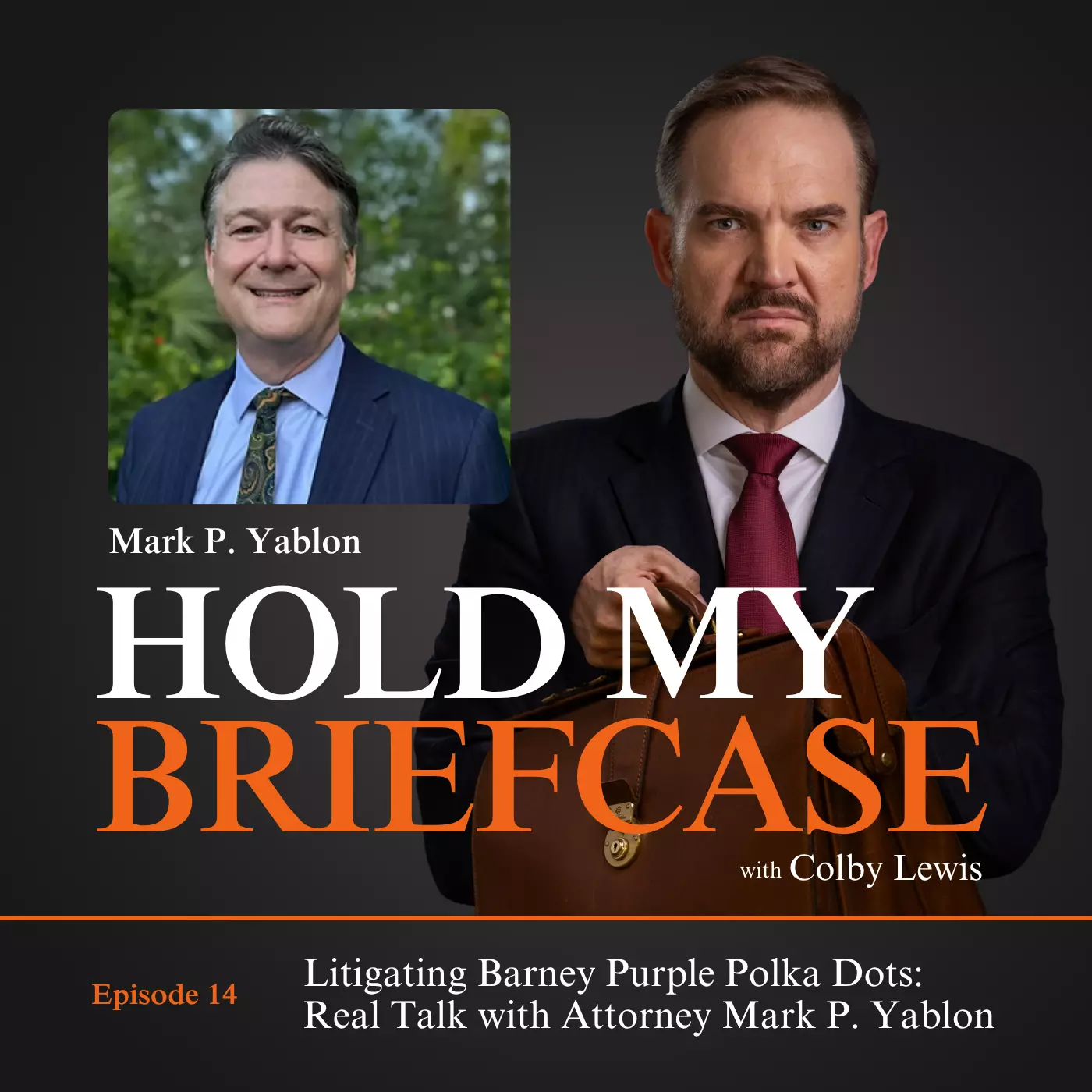
Avoiding Probate & Winning Commercial Disputes: Real Talk with Mark Yablon
Episode Summary In Episode 14 of the Hold My Briefcase podcast, Houston trial lawyer Colby Lewis brings on former journalist, financial advisor, and current managing attorney Mark P. Yablon to demystify commercial litigation and estate planning. Attorney Yablon breaks down the immense financial power of the Transfer on Death Deed (TODD)—a simple piece of paper that allows Texas homeowners to pass property to their children instantly while shielding the asset from federal Medicaid recovery claims. Drawing on his unique background, Yablon explains why legal contracts should be written in plain English, how to outmaneuver corporate defendants hiding assets during a lawsuit, and why you must build a relationship with a trusted attorney before a process server knocks on your door.
Key Takeaways from Episode 014
- The Power of the TODD: A Transfer on Death Deed allows your real estate to automatically transfer to your chosen beneficiaries the second you die, bypassing the probate court entirely.
- Shielding Assets from Medicaid: If the government pays for your long-term nursing home care, they will try to seize your house when you die to recover the costs. A properly filed TODD legally blocks this seizure.
- Set Up Payable on Death Accounts Today: You do not need a lawyer to protect your cash. Walk into your bank and sign a “Payable on Death” form to ensure your money transfers directly to your family without going through probate.
- Plain English Contracts Win: Contracts written in dense, archaic “legalese” cause disputes. Rewrite commercial leases and business agreements in plain English so everyone understands their actual obligations.
- The Zero-Dollar Appeal Bond: Under Texas law, an appeal bond is tied to your net worth. If a client is broke, a skilled lawyer can force a judge to accept a $0 supersedeas bond, preventing the winning side from collecting during the appeal.
- Build the Relationship Early: You only have about three weeks to respond after being sued. Do not wait until you are served with papers to start looking for a competent commercial litigation lawyer.
Episode Breakdown: Real Estate Protection and Courtroom Tactics
[02:43] Shielding Your Home with a Transfer on Death Deed
A Transfer on Death Deed (TODD) is the most effective way to protect a family home from government seizure. When an elderly person runs out of cash, Medicaid steps in to pay their $10,000-a-month nursing home bills. Medicaid considers this a loan. When the person dies, the federal government initiates the Medicaid Estate Recovery Program (MERP), forcing the sale of the person’s house to repay the medical debt.
A TODD completely bypasses this trap. You sign the deed today and file it with the county clerk. It acts like a shadow transaction: you retain total control of the house while you are alive, but the exact second you pass away, ownership instantly transfers to your designated beneficiary. Because the house never enters the probate estate, Medicaid cannot touch it.
| Property Transfer Route | Mediation / Probate Court Exposure & Asset Risk |
|---|---|
| Standard Probate Track | The home passes into the formal probate estate. It is exposed to time-consuming court validation and is fully vulnerable to Medicaid Estate Recovery Program (MERP) claims. |
| Transfer on Death Deed (TODD) | The home transfers automatically to beneficiaries the instant the owner passes away. Bypasses probate entirely, completely shielding the property from government asset recovery. |
[04:27] Payable on Death Accounts: The Free Estate Plan
You do not need to pay an attorney thousands of dollars to protect your liquid cash. Go to your bank and request a “Payable on Death” (POD) or “Transfer on Death” form for every account you own. By naming a beneficiary on these accounts, the funds will bypass the probate court entirely and escape standard creditor claims upon your death. It is the fastest, cheapest estate planning tool available.
[05:04] Why Contracts Must Be Written in Plain English
The legal industry is notorious for drafting contracts filled with dense, unreadable jargon. Mark Yablon, leaning on his journalism background and the teachings of legal writing expert Bryan Garner, actively rewrites commercial leases in plain English. If a contract is confusing, it will inevitably lead to a lawsuit. Clear, direct language prevents business disputes before they happen.
[07:34] Commercial Litigation: The Barney Purple Polka Dots Case
Commercial litigation is simply a business suing another business over a broken promise. To illustrate how bizarre these disputes can get, Mark recounts a recent trial in Collin County where a commercial subtenant illegally painted the interior of an office building with “Barney purple polka dots.”
During the lawsuit, the defendant attempted to execute a fraudulent transfer—quietly moving assets into a newly created company to avoid paying the judgment. Mark cornered the defendant on the witness stand, exposing the asset protection scheme and securing an award for total attorney fees.
[09:42] Forcing the Court to Accept a $0 Supersedeas Bond
When you lose a major lawsuit, the winning side can immediately start seizing your bank accounts. To stop this while you appeal the decision, you must file a “supersedeas bond.” The law states this bond is calculated based on the debtor’s net worth.
Mark represented a client who was completely broke but facing a $400,000 judgment. Following the strict letter of the law, Mark filed a $0 supersedeas bond. The judge was furious, asking if Mark seriously expected him to approve a zero-dollar bond on a massive judgment. Mark confidently replied that he wasn’t asking for approval—the law already mandated it.
“Mr. Yablon, are you really trying to tell me that on a $400,000 judgment I’m supposed to approve this $0 supersedeas [bond]? Yes, your honor. That’s exactly what I’m saying. Except I’m not asking you to approve it, because it’s already approved under the law.” — Mark Yablon
Frequently Asked Questions (Answered in this Episode)
What is a Transfer on Death Deed (TODD) in Texas? A Transfer on Death Deed is a specialized legal document filed with the county clerk that automatically transfers ownership of real estate to a designated beneficiary the moment the owner dies. This allows the property to completely bypass the expensive and slow probate court process.
Can a Transfer on Death Deed protect my house from Medicaid? Yes. If Medicaid pays for a person’s long-term nursing care, the state will use the Medicaid Estate Recovery Program (MERP) to seize the person’s estate after they die. Because a Transfer on Death Deed legally transfers the property outside of the probate estate, the state cannot seize the house to pay the medical debt.
What is a payable on death (POD) bank account? A payable on death (POD) designation is a free form provided by your bank. It dictates exactly who receives the money in your checking, savings, or investment accounts the moment you pass away, bypassing lawyers, probate courts, and standard creditor claims entirely.
What is a supersedeas bond in Texas litigation? A supersedeas bond is a financial deposit a losing party must post to stop the winning side from seizing their assets while the case is being appealed. Under Texas law, the amount of the bond is capped based on the losing party’s actual net worth.
Why should I build a relationship with a business lawyer before I get sued? If you are served with a lawsuit in Texas, you generally have only three weeks to file a formal legal response. High-quality commercial litigators are often booked months in advance. Having an established relationship with an attorney ensures you have immediate legal protection the second a crisis hits.
About the Attorneys
Mikel Colby Lewis is the managing partner and lead trial lawyer at The Law Offices of Colby Lewis. From his downtown Houston headquarters, Colby represents plaintiffs across Texas in high-stakes catastrophic personal injury claims, commercial litigation, and construction defect lawsuits (exclusively representing building owners). He is a top-15% graduate of the University of Houston Law Center and a 14-year consecutive member of the Texas Bar College.
Mark P. Yablon is the founding attorney of Yablon Law. With a 25-year background in business, real estate, and finance prior to entering the legal field, Mark handles complex commercial litigation, bankruptcy, and probate cases across Texas. His firm operates on a strict “no yelling, no jerks” policy, delivering aggressive legal advocacy grounded in plain English.
Don’t Wait Until You’re Sued to Find a Lawyer
Whether you need to shield your real estate from the government or require aggressive representation in a complex commercial business dispute, immediate action is required. Do not let the clock run out on your legal rights.
Call The Law Offices of Colby Lewis to secure your legal strategy today.