Episode Summary
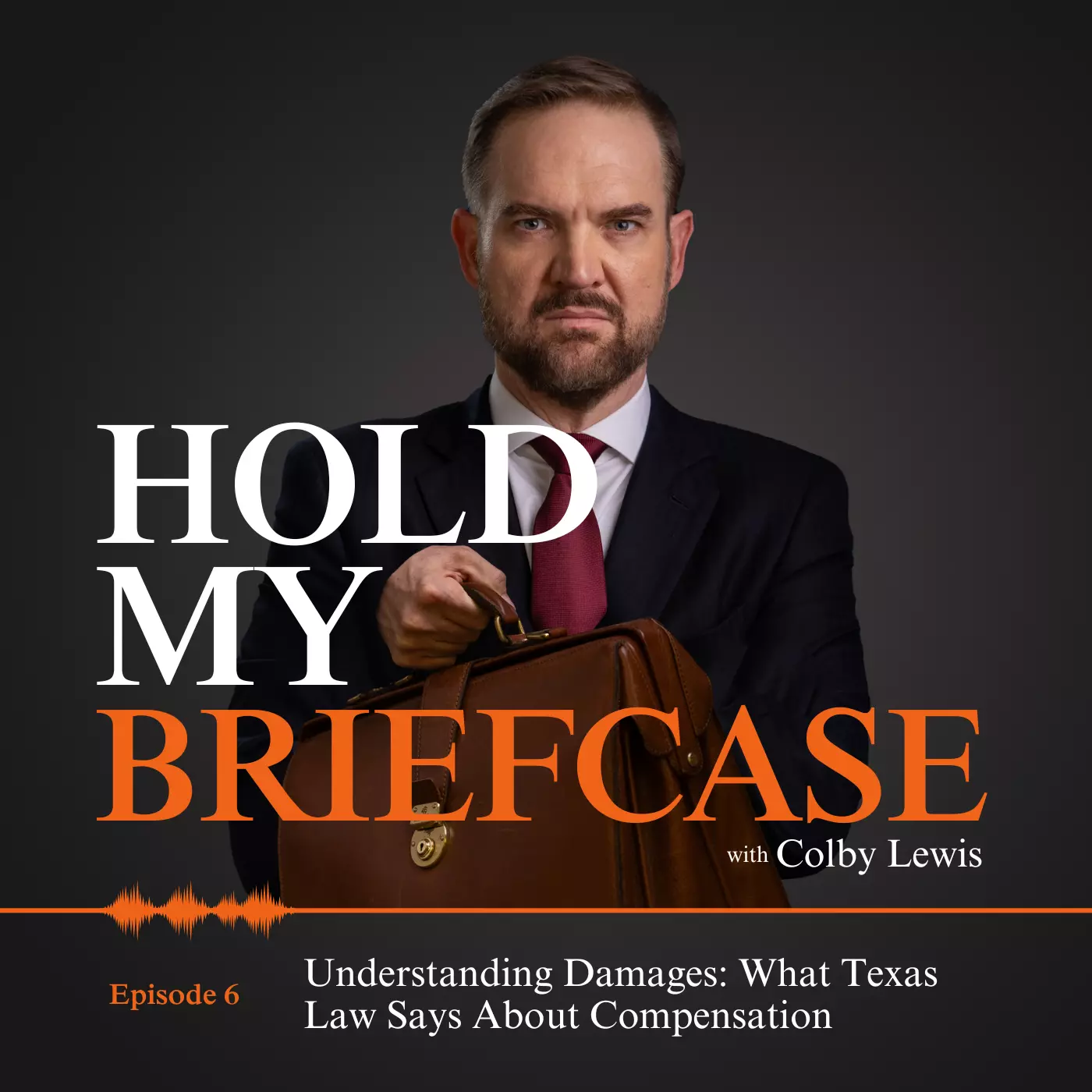
In Episode 6 of the Hold My Briefcase podcast, Houston personal injury lawyer Colby Lewis uncovers the mechanisms of recovering economic damages under modern Texas law. As insurance lobbyists and conservative legislative changes make it increasingly difficult for accident victims to secure fair compensation, understanding your evidentiary burdens is vital. This episode outlines the three primary categories of economic damages: lost wages, loss of earning capacity, and future medical care. Attorney Lewis clarifies the technical legal differences between actual past losses and long-term future projections, explaining why Texas courts strictly prohibit jury speculation. Listeners will discover exactly what documents are needed to prove lost pay with reasonable certainty, when the Texas Rules of Evidence mandate expert witness testimony, and how a vocational expert calculates lifetime career deficits.
Key Takeaways from Episode 006
- The Evolving Texas Legal Climate: Intense lobbying from insurance companies has influenced the Texas Legislature and the elected Texas Supreme Court to restrict damage recoveries, making strong evidence critical.
- Defining Economic Damages: Economic damages are financial losses resulting from an injury that can be quantified with a specific monetary calculation.
- The Three Pillars of Economic Loss: Texas law allows victims to seek reimbursement for three distinct financial elements: past lost wages, future loss of earning capacity, and future medical care.
- The “Reasonable Certainty” Standard: Proving lost wages requires absolute, concrete documentation. Texas courts reject guesses, requiring verifiable documents like W-2s, pay stubs, and explicit employer letters.
- Lost Wages vs. Earning Capacity: While lost wages cover fixed, historic income missed during recovery, loss of earning capacity measures your diminished ability to generate income over the rest of your working life.
- When Experts are Legally Mandated: Layperson juries can calculate basic past hourly lost wages from pay stubs, but complex compensation structures, self-employment commissions, and permanent vocational restrictions require certified economic or medical experts.
Episode Breakdown: Proving Financial Losses in a Personal Injury Suit
[00:30] The Political Realities of Texas Damage Recoveries
Recovering legal damages in Texas is becoming increasingly difficult. Because the Texas Supreme Court and the Texas Legislature are elected bodies, they are heavily influenced by well-funded insurance company lobbyists. Over recent years, a systematic shift has occurred to make the recovery of personal injury damages significantly more conservative. To overcome this systemic defense environment, you must approach your personal injury claim equipped with precise, bulletproof evidence.
[01:29] The Core Categories of Economic Recovery
When you are injured due to negligence, Texas civil law permits the recovery of economic damages. These are the specific elements of harm that carry a clear, calculable financial cost. Specifically, Colby breaks down the three foundational economic elements that every accident victim must evaluate:
- Lost Wages
- Loss of Earning Capacity
- Future Medical Care
[01:54] Proving Past Lost Wages with “Reasonable Certainty”
Lost wages represent the precise amount of cash you would have earned at your regular job if you hadn’t been injured. Texas law enforces a strict legal standard called reasonable certainty. You are legally barred from guessing or estimating your losses. To satisfy the court, you must construct an undisputed paper trail demonstrating that you were employed, that a medical professional ordered you to miss work, and that a precise calculation matches your missed shifts.
The Crucial Lost Wages Evidence Checklist:
- Tax Documentation: Past W-2 forms or tax filings verifying regular pre-accident baseline income.
- Earning Verification: Recent, consecutive pay stubs showing your specific hourly rate or salary.
- Signed Employer Statements: A formal letter from your company confirming the precise hours or shifts you missed and your exact compensation rate.
- Medical Authorization: Clear entries in your medical records or a direct doctor’s note explicitly stating your physical injuries prevented you from performing your job duties.
“Texas law requires reasonable certainty when you’re proving lost wages, which means that you must provide clear evidence that shows how much money you lost… You take your hourly rate, you take the amount of time you missed, you multiply them together, and that’s your claim.” — Colby Lewis
[06:40] Self-Employment, Commissions, and the Texas Rules of Evidence
Calculating lost income gets complicated if you are an independent contractor, an entrepreneur, or a worker dependent on commissions. A layperson jury can easily multiply hourly wages by missed days, but they cannot inherently calculate fluctuating business profits or lost sales pipelines. Under the Texas Rules of Evidence, when data falls outside the general knowledge of an average person, you must retain an economic expert to calculate and validate your speculative losses for the court.
[07:47] Loss of Earning Capacity: The “Delta” of Future Income
Loss of earning capacity focuses entirely on your reduced ability to earn a living in the future. To explain this complex element, Colby provides a specific, practical example: Imagine a trash truck worker who earns $100,000 a year but suffers a catastrophic accident resulting in the amputation of an arm. Because he can no longer physically lift heavy containers or meet the medical demands of that job, he is forced into an office role paying only $60,000 a year.
The annual difference—a $40,000 “delta”—multiplied over the remainder of his expected working life, represents his loss of earning capacity.
[08:16] Why Future Career Claims Demand Expert Witnesses
Texas courts will never allow a jury to guess or speculate about what a person’s future financial trajectory might have been. To win a loss of earning capacity claim, you must back it up with expert testimony. First, a medical expert must testify that your physical or cognitive injuries are permanent, detailing specific work restrictions (e.g., inability to stand, bend, or lift). Second, a vocational expert takes those medical limits, runs an analysis on your career skills, and issues a formal expert report establishing exactly what jobs you can no longer perform and what your lifetime economic deficit looks like.
Frequently Asked Questions (Answered in this Episode)
What is the difference between lost wages and loss of earning capacity in Texas? Lost wages focus entirely on past, measurable income you already missed while recovering from an accident. Loss of earning capacity measures the future; it compensates you for your permanent reduction in your ability to make money over the remainder of your life due to a lasting injury.
What is the legal definition of “reasonable certainty” in Texas personal injury law? Reasonable certainty is an evidentiary standard requiring a plaintiff to prove damages with objective, verifiable data rather than speculation or guesswork. For financial losses like lost wages, this means providing hard documentation like pay stubs, W-2s, and employer timesheets.
Can I claim lost wages if I am self-employed or work on commission in Texas? Yes, you can claim lost wages if you are self-employed or earn commissions, but your burden of proof is higher. Because your income fluctuates, you cannot simply show a basic pay stub; you will likely need an economic expert to analyze your business tax returns, profit-and-loss statements, and historical performance to project your true losses.
Do I need an expert witness to claim future medical care damages? Yes. Texas courts do not allow a jury to guess what medical treatments you might need down the road. You must present testimony from a medical doctor or a life care planner establishing the specific surgeries, therapies, or medications you will require in the future, along with verified costs.
Why are Texas personal injury laws considered conservative? Texas injury laws have become increasingly conservative due to decades of legislative tort reform driven by powerful insurance company lobbyists. Additionally, the Texas Supreme Court is an elected judicial body that has consistently issued rulings raising the evidentiary standards required for injured victims to successfully recover damages.
About Colby Lewis
Mikel Colby Lewis is a highly accomplished trial attorney, managing partner, and founder of The Law Offices of Colby Lewis. From his headquarters in downtown Houston, Colby advocates for victims across Texas in cases involving trucking collisions, personal injury, insurance bad faith, and complex construction defect lawsuits representing building owners. Colby earned his law degree from the University of Houston Law Center, finishing in the top 15% of his class while serving as a research editor for the Journal of International Law. He is a 14-year consecutive milestone member of the Texas Bar College, widely known for his direct, common-sense legal approach and unwavering commitment to forcing insurance companies to pay what they owe.
Stop Fighting Insurance Companies Alone. Get Expert Representation.
Insurance defense lawyers and corporate adjusters know every trick in the book to downplay your lost income and clear out your future medical coverage. Don’t let them split your compensation in half.
Call The Law Offices of Colby Lewis today for a free, direct, and actionable consultation.