
Quick answer: In Texas, if you sue an engineer or architect, the expert affidavit you file with your petition, called a certificate of merit, has to say what each professional did wrong and the facts behind it. On September 29, 2026, the Fifteenth Court of Appeals held in Encotech Engineering Consultants, Inc. v. Miramon that a certificate blaming several engineering firms together as “the relevant party(ies)” does not meet Texas Civil Practice and Remedies Code § 150.002(b). The certificate either has to tie each firm to its own errors, or clearly state that the firms were involved in all aspects of the work. Saying the firms “worked upon” the project is not enough. The court reversed the trial judge, who had let the claim go forward, and sent the case back to decide whether the dismissal will be with or without prejudice.
I am Colby Lewis. I represent people hurt by buildings, job sites, and the companies that design and build them. This case matters to anyone with an injury claim against a design professional, because it shows how a claim can be thrown out before anyone looks at the evidence, purely over how the expert wrote the affidavit.
Puntos clave
- One defendant, one set of errors. A certificate of merit has to identify each licensed professional and that professional’s specific conduct. Group blame is not allowed.
- The “all aspects” escape route is narrow. You can name several firms together only if the expert attests they were each involved in all aspects of the work. “Known or reasonably believed to have worked upon” the project does not count.
- Boilerplate is its own problem. Allegations like “failed to inspect, failed to warn, violated applicable regulations” with no facts behind them fail the factual-basis requirement even if everything else is right.
- A defendant’s admission helps only if it is specific. A firm admitting it did “MEP engineering” for a building does not tie it to the fan that caused the injury.
- A deficient certificate may not be the end. Under the Texas Supreme Court’s May 2026 decision in Studio E. v. Lehmberg, a dismissal without prejudice can be followed by an amended petition with a proper certificate.
What happened at Austin Fire Station 51
In June 2023, Austin firefighter Ian Miramon was inspecting a fire truck inside Station 51 when, according to the lawsuit, the blade of an industrial ceiling fan struck him in the head and knocked him off the top of the truck onto the concrete floor. He and his wife sued Encotech Engineering Consultants and several other companies for negligence and gross negligence in the design, construction, and inspection of the fan and the station.
Because some of the defendants were licensed engineering firms, Texas law required the Miramons to file a certificate of merit with their original petition. Their expert, a professional engineer, swore that “the relevant party(ies)” failed to design the station safely, failed to install the fan in a safe location, failed to inspect, failed to warn, failed to retrofit, and violated applicable regulations and industry standards. The core technical opinion was specific and sensible: the fan did not have enough clearance above the truck, and with safe clearance the incident would not have happened.
Encotech moved to dismiss, arguing that the expert was not qualified and that the certificate never said what Encotech, as opposed to the other firms, did wrong. The trial court denied the motion. Encotech took an immediate appeal, which § 150.002(f) allows. The Texas Supreme Court transferred the appeal from the Austin court to the Fifteenth Court of Appeals to even out the courts’ workloads.
The rule: name the firm, name the error, give the facts
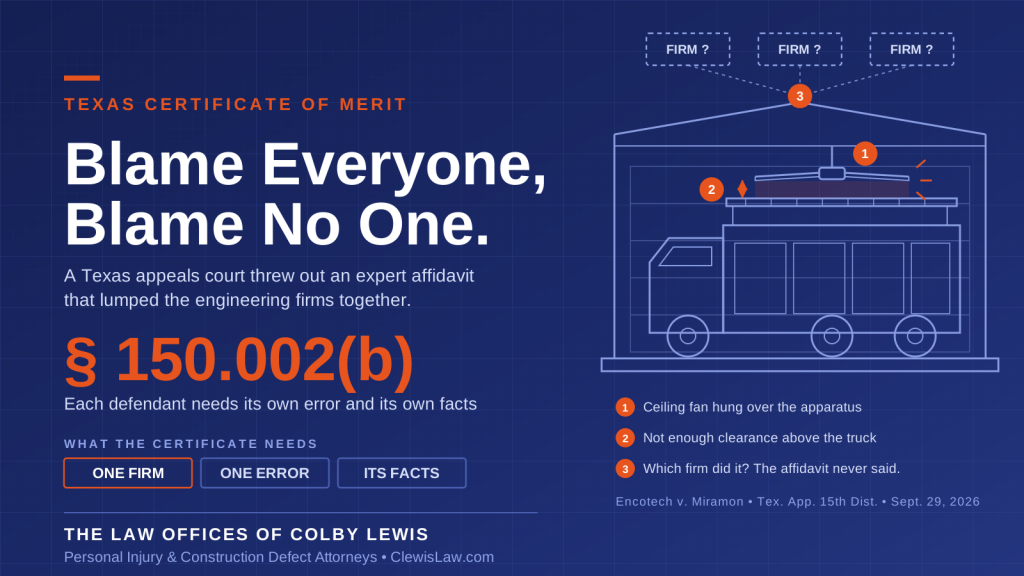 Section 150.002(b) requires the certificate to “set forth specifically for each theory of recovery” the negligence or other error “of the licensed or registered professional,” and “the factual basis for each such claim.” The Texas Supreme Court has said the expert does not have to address the elements of each cause of action or lay out all the evidence. Melden & Hunt, Inc. v. East Rio Hondo Water Supply Corp., 520 S.W.3d 887, 896 (Tex. 2017). But the expert does have to attest to the defendant’s errors and their factual basis.
When there is more than one defendant, Texas courts read that to mean the judge must be able to tell which acts or omissions belong to which company. The alternative is a certificate that says the defendants “were involved in all aspects of the work.” The Fifteenth Court applied that rule and found the Miramons’ certificate did neither. It never described a single firm’s individual conduct. Every error was attributed to the group.
The stakes are high. A noncompliant certificate “shall result in dismissal” of the claim, and the dismissal may be with prejudice. Tex. Civ. Prac. & Rem. Code § 150.002(e). The Texas Supreme Court has described the statute as giving professionals the right to avoid litigation entirely absent a proper certificate. LaLonde v. Gosnell, 593 S.W.3d 212, 220 (Tex. 2019).
Three ways the plaintiffs tried to save the certificate, and why each failed
1. “The firms were involved in all aspects of the work”
The certificate listed the engineering firms “known or reasonably believed to have worked upon the design and/or construction of Fire Station 51.” The court said that sentence shows only that each firm worked on the station in some capacity. One firm might have designed the building and never built it. Another might have handled only the plumbing. Nothing in that sentence says every firm touched every part of the job, including the fan placement. The court noted other Texas courts have rejected similar wording, such as a certificate saying “Defendant Architectural Firms designed the retaining wall” and another saying the defendants failed to “adequately or appropriately design the pipeline.”
The petition did not help either. It also described the defendants only collectively.
2. “Encotech admitted it worked on the station”
In its motion to dismiss, Encotech said it “provided mechanical, electrical and plumbing engineering services” for Station 51. The Miramons pointed to two Houston First Court of Appeals decisions, T & T Engineering Services v. Danks (2022) and Bratton v. Pastor, Behling & Wheeler (2024), where a defendant’s own admissions filled the gap in a group-blame certificate.
The Fifteenth Court assumed, without deciding, that a court can look at those admissions. It still found the argument failed. In T & T, the defendant admitted it designed the exact rig and derrick board that hurt the plaintiff. In Bratton, the defendants admitted performing the specific environmental work the certificate criticized. Encotech’s admission was about the building generally. It said nothing about the fan or the truck clearance. For all the record showed, Encotech’s MEP work had nothing to do with the fan.
3. “Other courts have accepted certificates like this”
The Miramons cited five cases where collective-negligence challenges failed. The court distinguished every one:
- The three Mond Homeowners Association cases (Houston Fourteenth Court, 2025) involved a glass curtain wall. The certificate there said who drafted the design and who negligently reviewed and failed to oversee it. Each firm had its own role.
- AMEC Foster Wheeler v. Maricelli (Beaumont, 2020) separately identified one defendant as the project’s technology licensee and another as the firm that designed the unit, then attested both failed to identify the hazard.
- Resource Planning Associates v. Sea Scout Base Galveston (Houston First Court, 2021) involved architects who had both sealed the drawings at issue. Sealing means the professional takes full responsibility for the work, and the expert attested both were involved in all aspects of it. No sealed documents were at issue in Miramon.
The pattern is clear. Where the certificate gives each defendant a role, lumping in one conclusion sentence can survive. Where it never gives anyone a role, it fails.
The second problem most readers will miss: boilerplate with no facts
Footnote 8 of the opinion is worth more to practitioners than the headline holding. Beyond the fan placement, the certificate alleged the firms failed to inspect the station for hazards, failed to warn, failed to remedy or retrofit, and violated government regulations and industry standards. The court held those allegations had no factual basis at all. The certificate never said what other hazards existed, how they related to the injury, or which regulation was violated.
That language, or something close to it, appears in a large share of the certificates and petitions I see. This opinion is a warning that every alleged error needs its own facts. A precise opinion about the fan clearance can be dragged down by a paragraph of catch-all failures the expert never supported.
What the court did not decide
- Whether the expert was qualified. Encotech argued he did not actively practice engineering. Because the collective-negligence ruling resolved the appeal, the court did not reach it.
- Whether the dismissal will be with or without prejudice. That goes back to the trial court. Citing Studio E. Architecture & Interiors, Inc. v. Lehmberg (Tex. May 29, 2026), the court said a dismissal without prejudice would not stop the Miramons from filing an amended petition with a compliant certificate.
- Limitations. The Miramons raised a possible limitations problem if their claims are dismissed and refiled. The court left that for the trial court, as Lehmberg did. The injury happened in June 2023, and Texas generally gives two years to file a personal injury claim, so the question is real.
The opinion also notes that the Miramons have since filed amended petitions with new certificates. The appeal concerned only the original certificate.
Why this matters if you were hurt
When someone is injured at work, workers’ compensation usually limits what they can recover from their own employer. The companies that designed, built, and inspected the place where they were hurt are often where the meaningful recovery is. Those companies frequently include licensed engineers and architects, and every one of them triggers the certificate of merit requirement.
That means the first filing has to be right. A claim against a design professional can be dismissed on the paperwork before a jury ever hears about the fan that was hung too low.
How to build a certificate of merit that survives
This is the checklist I work from on claims against design professionals:
- Find out who did what before the expert writes anything. Sealed drawings, the professional’s own proposal and contract, permit files, and submittals usually show scope. For a public building like a fire station, those records may be obtainable through a Texas Public Information Act request.
- Write one section per defendant. Each one should state the professional’s role, the specific error or omission, the facts the expert relied on, and how it connects to the injury.
- Use “all aspects of the work” only when it is true, and say why. If two firms jointly sealed the drawings, say so. A general statement that firms “worked on” the project is not the same thing.
- Give every alleged error its own facts. If the expert cannot support “failed to warn” or “violated regulations” with facts, cut it. A shorter certificate with specific opinions is stronger than a long one with boilerplate.
- Match the expert to the defendant. En affiant must hold the same license as the defendant and practice in the same area. Encotech challenged the expert’s qualifications here. The court did not reach that argument, but the defense will raise it every time.
- Do not count on the defense to fill your gaps. A defendant’s admission helps only if it ties that defendant to the specific thing that caused the injury.
- File with time to spare. A certificate written in the final week before limitations runs leaves no room to fix a defect.
Para abogados remitentes
If you have an injury case with a building, equipment, or design component and an engineer or architect may be involved, bring us in before the petition is drafted. The certificate of merit is where these claims are won or lost early, and it has to be built around the facts of each defendant’s scope. We co-counsel and accept referrals on premises, workplace, and construction injury cases across Texas, and we handle the expert work from the start.
Talk to us before the clock runs
If you or a family member was hurt because of how a building or job site was designed, built, or inspected, the deadlines and filing rules start early. Call (866) 265-2948 or request a free case review.
Preguntas frecuentes (FAQ)
What is a certificate of merit in Texas?
It is a sworn affidavit from a third-party licensed architect, professional engineer, landscape architect, or land surveyor that must be filed with the first pleading asserting a claim for damages arising from a licensed design professional’s services. Tex. Civ. Prac. & Rem. Code § 150.002(a). It must state, for each theory of recovery, the professional’s negligence or other error and the factual basis for each claim. § 150.002(b).
Can one certificate of merit cover several engineering firms?
Yes, but only if it identifies each firm’s specific conduct, or clearly attests that the firms were each involved in all aspects of the work. In Encotech Engineering Consultants, Inc. v. Miramon (Tex. App. Sept. 29, 2026), a certificate referring to the firms only as “the relevant party(ies)” was held deficient.
What happens if a certificate of merit is deficient?
The claim against that professional must be dismissed, and the dismissal may be with prejudice. Tex. Civ. Prac. & Rem. Code § 150.002(e). The trial court decides which.
Can you refile after a certificate of merit dismissal?
If the dismissal is without prejudice, the Texas Supreme Court held in Studio E. Architecture & Interiors, Inc. v. Lehmberg (Tex. May 29, 2026) that the plaintiff can file an amended petition with a compliant certificate. Whether the refiled claim is barred by limitations is a separate question.
Does a certificate of merit apply to personal injury cases?
Yes. The requirement applies to any action for damages arising out of a licensed design professional’s services, including claims by people injured because of how a building or structure was designed. Encotech v. Miramon was a personal injury case brought by a firefighter.
Is listing every possible failure in the certificate a safe approach?
No. In Encotech, the court held that general allegations such as failing to inspect, warn, or comply with regulations had no factual basis and did not satisfy § 150.002(b). Every alleged error needs facts behind it.
Authorities Cited
Statutes
- Tex. Civ. Prac. & Rem. Code § 150.001 (definitions)
- Tex. Civ. Prac. & Rem. Code § 150.002 (certificate of merit)
- Tex. Civ. Prac. & Rem. Code § 16.003 (two-year limitations for personal injury)
- Tex. Gov’t Code § 73.001 (docket-equalization transfers)
- Tex. Gov’t Code ch. 552 (Texas Public Information Act)
Cases
- Encotech Eng’g Consultants, Inc. v. Miramon, No. 15-25-00173-CV, 2026 WL 2930606 (Tex. App.—15th Dist. Sept. 29, 2026) (mem. op.)
- Studio E. Architecture & Interiors, Inc. v. Lehmberg, No. 24-0286, 2026 WL 1500909 (Tex. May 29, 2026)
- LaLonde v. Gosnell, 593 S.W.3d 212 (Tex. 2019)
- Melden & Hunt, Inc. v. E. Rio Hondo Water Supply Corp., 520 S.W.3d 887 (Tex. 2017)
- Robert Navarro & Assocs. Eng’g, Inc. v. Flowers Baking Co. of El Paso, LLC, 389 S.W.3d 475 (Tex. App.—El Paso 2012, no pet.)
- Bratton v. Pastor, Behling & Wheeler, L.L.C., No. 01-23-00015-CV, 2024 WL 1662391 (Tex. App.—Houston [1st Dist.] Apr. 18, 2024, pet. denied) (mem. op.)
- T & T Eng’g Servs., Inc. v. Danks, No. 01-21-00139-CV, 2022 WL 3588718 (Tex. App.—Houston [1st Dist.] Aug. 23, 2022, pet. denied) (mem. op.)
- Fluor Enters., Inc. v. Maricelli, No. 09-19-00121-CV, 2020 WL 2070257 (Tex. App.—Beaumont Apr. 30, 2020, pet. denied) (mem. op.)
- Macina, Bose, Copeland & Assocs. v. Yanez, No. 05-17-00180-CV, 2017 WL 4837691 (Tex. App.—Dallas Oct. 26, 2017, pet. dism’d) (mem. op.)
- In re Channelview Flooding Litig., No. 01-22-00946-CV, 2024 WL 5249085 (Tex. App.—Houston [1st Dist.] Dec. 31, 2024, pet. denied) (mem. op.)
- EDI Int’l, PC v. Mond Homeowners Ass’ns, Inc., No. 14-23-00958-CV, 2025 WL 798073 (Tex. App.—Houston [14th Dist.] Mar. 13, 2025, no pet.) (mem. op.), and companion cases Henderson Rogers Structural Eng’rs, LLC (2025 WL 798081) and Ryan Eng’g, Inc. (2025 WL 798075)
- AMEC Foster Wheeler USA Corp. v. Maricelli, No. 09-19-00122-CV, 2020 WL 3579567 (Tex. App.—Beaumont July 2, 2020, no pet.) (mem. op.)
- Res. Plan. Assocs., LLC v. Sea Scout Base Galveston & Point Glass, LLC, No. 01-19-00965-CV, 2021 WL 1375797 (Tex. App.—Houston [1st Dist.] Apr. 13, 2021, pet. denied) (mem. op.)
This article provides general information about Texas law. It is not legal advice, and reading it does not create an attorney-client relationship with Colby Lewis or The Law Offices of Colby Lewis. Certificate of merit requirements, filing deadlines, and the other rules described here are fact-specific and change over time. The case discussed is a memorandum opinion and may be subject to further review. Do not act or refrain from acting based on this article. Consult a licensed Texas attorney about your specific situation. The Law Offices of Colby Lewis, Houston, Texas. Attorney advertising. Prior results do not guarantee or predict a similar outcome in any other matter.
