
And the Birth of Construction Law
How building made us human, from the first temples to the modern skyline, and why the law has always asked the same question: who bears the risk when the work fails?
By M. Colby Lewis, Construction Defect Attorney, The Law Offices of Colby Lewis, Houston, Texas
This is the first post in our Foundations Series, a plain-English walk through the ideas behind modern construction law, guided by the leading treatise in the field, Bruner & O’Connor on Construction Law. We represent building owners, so everything here is written from the owner’s side of the table.
The short version
For more than forty centuries, construction has marked the rise of civilization. People built monuments before they farmed, raised cities out of river mud, and cut stone into wonders meant to outlast empires. For most of that history a single master builder designed the work and answered for the result, and the law held him to it: Hammurabi’s Code put a builder to death if his house collapsed and killed the owner, and ancient Greek law made an architect personally liable for cost overruns above 25 percent. As building grew more complex, the law of building grew with it. But the question at the heart of every construction dispute has never changed: who controlled the work, and who bears the risk when it fails?
Why Is Construction the Measure of a Civilization?
Construction is the measure of a civilization because building is what a society leaves behind, and building is what organized it in the first place. This post explores the four-thousand-year survey with a simple observation: agriculture fed the human race, but construction announced it.
For well over 4,000 years, the advance of civilization has been written in stone and brick: roads and bridges for travel, harbors and lighthouses for the sea, walls and moats for protection, aqueducts and cisterns for water, coliseums for spectacle, schools for learning, temples and cathedrals for worship, and monuments to honor the dead and glorify the living.
Early farming turned a family inward, toward its own fields. Construction did the opposite. It pulled large numbers of people together to plan and complete a shared project, and it made cities worth living in. Building is the original act of social organization.
The ancients knew it, too. Around 75 A.D., the historian Plutarch looked back at the Athens of Pericles, four centuries earlier, and wrote that the city’s public and sacred buildings gave “the greatest admiration and even astonishment to all strangers,” and stood as “Greece’s only evidence that the power she boasts of and of her ancient wealth are no romance or idle story.” When Plutarch wanted evidence that a great civilization had really existed, he pointed at its construction. Archaeologists do the same thing today, whether they are excavating the 5,000-year-old walls of Troy on the Turkish coast or measuring the ruins of a Roman “university town” built around 298 A.D. near modern Autun, France. When we measure a lost civilization, we measure its ruins.
Did Building Really Come Before Farming?
 At the oldest monumental site ever found, yes. We used to assume the order was obvious: people learned to farm, settled down, found spare time, and only then built temples. A hill in southeastern Turkey upended that story. At Göbekli Tepe, archaeologists uncovered rings of carved limestone pillars up to sixteen feet tall and weighing as much as seven tons, raised roughly 11,000 years ago by hunter-gatherers who had not yet invented pottery or metal tools. The site predates Stonehenge by some 7,000 years.
Erecting those pillars took hundreds of workers who all had to be fed and housed. The site’s lead archaeologist, Klaus Schmidt, argued that the monument came first and the settled community formed around it, not the other way around. Stanford archaeologist Ian Hodder, who excavated the prehistoric settlement of Çatalhöyük 300 miles away, put it flatly: the social and cultural changes came first, and agriculture came later. In other words, the urge to build may have helped invent agriculture, not the reverse.
The evidence keeps piling up. Researchers have now documented more than twenty Neolithic sites in modern Turkey dating back 10,200 to 12,000 years. At a 12,000-year-old village called Nahal Ein Gev II, archaeologists found homes built to a uniform plan in layers of heavy stone, and drew the obvious conclusion: you don’t go to that kind of trouble if you’re leaving in a few months. Even Stonehenge turns out to have a continental cousin, a 4,000-year-old ring sanctuary discovered at Pömmelte, Germany. Construction did not follow civilization. It helped create it.
IN PLAIN ENGLISH, FROM COLBY
Here’s the deal. Before people figured out farming, before writing, before the wheel, they were already organizing hundreds of workers to raise seven-ton stones on a hilltop. Think about what that actually takes, right? Somebody has to plan it. Somebody has to feed the crew. Somebody has to decide who does what, and somebody has to answer for it if a pillar falls on someone. That’s a construction project, and every construction project, whether it’s 11,000 years ago in Turkey or last year in Houston, runs on the same thing: a bunch of people relying on promises. The moment you have promises, you need rules for what happens when somebody breaks one. That’s all construction law is. It’s as old as the first stone they stood upright.
How Did the First Cities Get Built?
 The first cities rose where rivers left behind clay, and they were built with it. Builders packed that clay into walls, then learned to press it into sun-dried mud bricks bound with mud mortar. Historians of building technology describe this as a major conceptual leap: from free-form mounds of packed clay to true rectangular architecture, prefabricated one brick at a time. Mud brick built the great Bronze Age cities, including Mohenjo-Daro on the flood plains of present-day Pakistan, home to perhaps 40,000 people five thousand years ago, and adobe construction descended from it is still in use across the Middle East, Africa, Asia, and Latin America.
By about 3000 B.C. in Mesopotamia, builders turned the pottery kiln on the brick itself. Fired brick was costly in labor and fuel, so it went first where the wear was worst: pavements, the tops of walls, and the brick-roofed sewers beneath the streets, where archaeologists have found the first true arches ever built. Mesopotamian masons stacked their mass-brick technology into ziggurats at Ur and Borsippa that rose 87 feet. The Book of Genesis remembers the technology in its own way, in the story of builders on the plain of Babel who said, “come, let us make bricks, and burn them thoroughly,” and set out to raise a tower with its top in the heavens.
No city captured the age better than Uruk, the great Sumerian metropolis whose ruins lie in southern Iraq. First settled about 7,000 years ago, Uruk grew into the largest city on earth, packing more than 50,000 people into roughly two and a half square miles at its peak around 2900 B.C. Archaeologists trace some of the earliest organized taxation, mass production, international commerce, and large-scale public art to Uruk, and there is little doubt the earliest system of writing matured there.
Uruk’s god-king Gilgamesh is the hero of the oldest surviving epic in world literature, written in cuneiform on clay tablets around 2750 B.C. And that poem opens not with a battle but with a guided tour of the city wall: climb the stone staircase, the poet says, walk the ramparts that gleam like copper, inspect the mighty foundations, examine the brickwork, see how masterfully it is built. The earliest epic we possess is, at heart, an invitation to admire good construction. It may also be history’s first quality inspection.
What Was the First Construction Defect Law in History?
The first construction defect law we know of is nearly 3,800 years old, and it did not fool around. Around 1750 B.C., the Babylonian king Hammurabi carved a code of laws into stone, drawing on even older collections of Sumerian and Akkadian law. Five of its provisions, sections 229 through 233, deal squarely with defective construction, and they read like a modern defect case with the penalties turned all the way up. In the classic 1910 translation by L.W. King, preserved by Yale Law School’s Avalon Project:
- If a builder build a house for some one, and does not construct it properly, and the house which he built fall in and kill its owner, then that builder shall be put to death.
- If it kill the son of the owner the son of that builder shall be put to death.
- If it ruin goods, he shall make compensation for all that has been ruined, and inasmuch as he did not construct properly this house which he built and it fell, he shall re-erect the house from his own means.
- If a builder build a house for some one, even though he has not yet completed it; if then the walls seem toppling, the builder must make the walls solid from his own means.
Set aside the brutality of the eye-for-an-eye penalties, which legal historians like Martha Roth have examined in depth, and look at the structure. Section 232 is a damages remedy: the builder who “did not construct properly” must compensate the owner for ruined property and rebuild the house at his own expense. Section 233 is even more striking. It imposes liability antes collapse, the moment the walls “seem toppling,” and requires the builder to fix defective work out of his own pocket. That is repair-and-remediation liability for observable defects, in stone, thirty-seven centuries before the first Texas construction defect statute.
The principle underneath has never changed: the party who controlled the construction answers for its failure. Every construction defect claim filed in a Texas courthouse today is a descendant of section 232.
IN PLAIN ENGLISH, FROM COLBY
I’ll be frank with you, this is my favorite law ever written. Thirty-seven hundred years ago, a king in Babylon looked at the building industry and said, here’s the rule: you built it, it falls down, you pay. You built it badly and it looks like it’s going to fall down? You fix it, at your cost, before it hurts somebody. Now, was the death penalty part a little much? Sure. We’ve softened the remedies. But ask yourself, what’s changed about the principle? Nothing. When I sit down with a building owner whose foundation is cracking or whose roof has leaked since the day the contractor left, we are asking Hammurabi’s question: who built this thing, and why should the owner eat the cost of someone else’s bad work? The answer was carved in stone before Moses, and it’s still the right answer.
Wonders Built to Outlast Empires
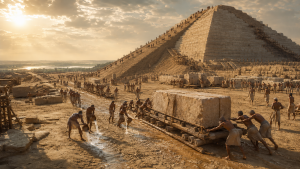 As technique matured, builders reached for permanence, and some of them achieved it. Around 2550 B.C., Egyptian crews raised the Great Pyramid of Giza from polished stone blocks, none less than thirty feet long, fitted so precisely they still hold. The Greek historian Herodotus, visiting two thousand years later, recorded what the Egyptians told him: a hundred thousand men working in three-month shifts, ten years just to build the track for hauling the stone, twelve more for the pyramid itself, each course lifted by lever contrivances of short timbers, tier by tier.
Modern archaeology has corrected Herodotus on one big point. He believed slaves built the pyramids. Excavations reported in Scientific American show the labor force was made up of paid Egyptian work gangs, an elite corps that also sailed trade missions hundreds of miles for supplies and materials. The organizational machine built to raise the pyramids, the researchers concluded, did more than move stone. It set the stage for centuries of Egyptian prosperity and altered the course of later civilizations. The project management came first; the prosperity followed.
Other civilizations built their own statements in stone. Stonehenge rose on the Salisbury Plain in three phases over twenty-five generations, its 45-ton stones hauled more than twenty miles and worked with ropes, timber levers, and deer-antler picks. Darius I founded Persepolis around 518 B.C., and construction continued for nearly 200 years, drawing stonemasons, painters, scribes, and cooks from across the Persian empire into a capital of 45,000 people whose largest hall held 72 columns and hosted crowds of 10,000. And the Pharos of Alexandria, the great lighthouse raised in 285 B.C., guided sailors for seventeen centuries. Chroniclers counted twenty-two significant earthquakes against it between 320 and 1303 A.D. It lost its upper story in 796, shed masonry for centuries, and finally fell to the great earthquake of 1303. When the Moroccan traveler Ibn Battuta passed through Alexandria in 1326, he could still climb the entrance ramp. When he returned in 1349, the lighthouse was a ruin. Seventeen centuries of service remains a durability record no modern structure has approached.
These were not just buildings. They were a civilization’s argument for its own importance, addressed to everyone who would come after.
What Does the Bible Say About Bad Foundations and Blown Budgets?
More than you might think, and it says it like a construction lawyer. Jesus of Nazareth, who is said to have practiced carpentry as a boy, reached for building metaphors constantly, and he chose the two failures that still dominate construction litigation: defective foundations and cost overruns.
He closed the Sermon on the Mount with a geotechnical lesson. The wise man built his house on rock, and when the rain fell and the floods came and the winds beat on that house, it did not fall, “because it had been founded on rock.” The foolish man built on sand, “and it fell, and great was its fall.” Matthew 7:24-27. Any Texas owner who has watched a slab founder on unstable soil knows exactly which house they bought.
And in Luke, he described the builder every era produces: “For which of you, desiring to build a tower, does not first sit down and count the cost, whether he has enough to complete it? Otherwise, when he has laid a foundation and is not able to finish, all who see it will begin to mock him.” Luke 14:28-30. Sixteen centuries later Shakespeare was still making the same point, mocking the man “that draws the model of a house beyond his power to build it.” The abandoned, half-finished project was familiar enough in the first century to preach about, and familiar enough in the seventeenth to put on stage.
Who Was the Master Builder?
For almost all of recorded history, one figure stood at the center of the building process: the master builder. The word “construction” described a single, unified craft. One person designed the project, hired the artisans to build it, oversaw the work hands-on, and answered for the whole. The role was so familiar in the ancient world that the Apostle Paul used it as a metaphor for his own ministry: “as a wise master builder I have laid the foundation.” 1 Corinthians 3:10.
The ancients even contracted the way the role demanded. The building accounts of the Parthenon show that each column was built under a separate contract with a master mason, which means one of the most celebrated buildings on earth was delivered through a web of individual trade contracts, twenty-four centuries before anyone said the words “subcontractor dispute.”
Only within the last century did architects hand off on-site management of the work to contractors, splitting design from construction into separate camps, a shift the architect and scholar Carl Sapers traced in his Ruminations on Architectural Practice. The old unified method never really died, though. We gave it a new name. Today we call it design-build, and it is marketed as an innovation. It is the oldest project delivery method in the world.
How Did Rome Engineer an Empire?
No ancient civilization industrialized building like Rome, and none tied its power so directly to construction. Beginning around 238 B.C., Rome built a road network that eventually ran some 200,000 miles, from northern England through Europe and around the North African coast. The poet Statius left a jobsite report from the via Domitiana that any modern road contractor would recognize: crews tracing the alignment, excavating a deep trench, refilling it with foundation material, holding the metalling with kerbing and wedges, felling timber, smoothing rock, and diverting streams to keep the cut dry. Build the road right, and it carried legions and merchants for centuries.
Roman bridge builders understood something modern courts still repeat: a structure is only as permanent as the foundation it stands on. In 62 B.C., Rome’s engineers bridged the Tiber to the island in its middle with the Ponte Fabricio, timing the treacherous underwater foundation work for summer low water, raising twin stone arches over temporary timber centering, and adding small relief arches to shed flood pressure. The bridge is more than 2,000 years old. It is still in use.
Their secret weapon was concrete. By mixing lime with pozzolana, a fine volcanic ash mined near Pozzuoli, the Romans produced a natural cement far stronger and more weather-resistant than lime mortar, one that would harden even underwater and resist the scour of a river current. As one construction engineer put it, the volcano had already done the kiln’s work: “the pozzolan was calcined by the volcano.” The Romans called the resulting material opus caementicium, and modern researchers have found that lime clasts in it give it a self-healing quality: when a crack forms and water seeps in, the lime reacts and re-seals the gap. A modern bridge is designed to last 50 to 100 years. Roman harbor concrete at Caesarea has survived two thousand years underwater.
With concrete and the arch, Rome solved the problems that decide whether a settlement becomes a city. Aqueducts on precise, gentle gradients, dropping as little as one foot over 500 feet of run, carried clean water for miles into cities of hundreds of thousands, and sewers carried waste away. Roman glassmakers produced the first clear window glass, blown as cylinders and laid flat; the philosopher Seneca described the sensation caused by the first glazed sun porches in the villas near Rome. Hadrian roofed the Pantheon with a single hemispherical concrete dome between 118 and 125 A.D., and four centuries later Justinian answered it with the Hagia Sophia. Walls defined the rest of the map. Julius Caesar, an engineer at heart, devoted part of his war commentaries to an admiring analysis of Gallic wall construction, alternating courses of 40-foot timbers and stone that resisted both fire and battering ram. The Great Wall of China eventually ran some 4,000 miles. Hadrian’s Wall crossed the 73-mile waist of Britain in about 120 A.D.
Vitruvius: When Building First Met the Law
Around 20 B.C., the architect and military engineer Marcus Vitruvius Pollio, who served Julius Caesar and then Augustus, wrote de Architectura, the only treatise on architecture to survive from antiquity. The University of Houston’s engineering historian John Lienhard has called Vitruvius “the chief engineer of the civilized world.” Across ten books he covered everything from siting cities and making bricks to designing temples, theaters, aqueducts, and machines. You can still read his ten books in full.
Three things Vitruvius wrote should sound familiar to any building owner today.
First, he demanded qualified professionals. Architecture, he wrote, is born of both practice and theory, and the builder armed with only one is “grasping the shadow instead of the substance.” He complained bitterly that “this grand art is boldly professed by the uneducated and unskillful,” men with no knowledge even of the carpenter’s trade, and he sympathized with owners who, burned by strangers, decided to build for themselves. Every modern licensing statute is chasing the problem Vitruvius named.
Second, he told architects to learn the law and put the deal in writing. An architect, he advised, should know the law of party walls, drainage, windows, and water supply, and should draft contracts with care, “so that in drawing up contracts the interests of both employer and contractor may be wisely safe-guarded. For if a contract is skillfully drawn, each may obtain a release from the other without disadvantage.” That sentence, written two thousand years before the AIA published its first form agreement, is still the best one-line summary of construction contracting ever produced.
Third, he wanted cost overruns to come out of the architect’s pocket. Vitruvius admired what he called an “ancient ancestral law” of the Greek city of Ephesus. There, an architect taking on a public work handed the magistrate a cost estimate, and his own property was pledged as security until the work was done. Finish on budget, and he received decrees and honors. Run up to one-fourth over, and the treasury absorbed it. But beyond 25 percent, the overage was taken from the architect’s own property. Vitruvius wished to God that Rome had the same law, for public y private buildings, so that “the ignorant would no longer run riot with impunity” and owners would no longer be driven to ruin by limitless expenditure. Lamenting his profession’s status, he added one of history’s great complaints: “architects deserve more honor than wrestlers.”
Rome’s contract law had teeth to match. The Roman principle pacta sunt servanda, “contracts must be kept,” imposed strict liability for non-performance unless the failure was excused under rebus sic stantibus, the doctrine that the deal presumes circumstances remain unchanged. Those two principles are still the load-bearing walls of contract law. The Restatement (Second) of Contracts opens its chapter on this subject the same way Rome would have: “Contract liability is strict liability. It is an accepted maxim that pacta sunt servanda, contracts are to be kept.” When Bruner and O’Connor observe that good Roman practice favored careful contractual articulation of the scope of work and allocation of construction risks, they are describing the reign of Augustus. They could be describing this morning.
IN PLAIN ENGLISH, FROM COLBY
Strip away the toga and look at what the Ephesus rule actually is. The architect gives you a number before the work starts. He pledges his own property behind that number. Come in on budget, he gets a parade. Blow the budget by more than 25 percent, and the overrun comes out of his pocket, not yours. What do we call that today? A fixed-price contract with a personal guarantee, right? Two thousand years ago the law had already figured out the whole game: put the risk of bad cost control on the person who controls the cost. And here’s the thing, every construction contract you’ll ever sign is just answering the same three questions the Romans were asking. What’s the work? What’s the price? And who eats it when something goes wrong? If your contract doesn’t answer that third question clearly, I promise you, somebody else’s lawyer already made sure it answers it in their favor.
From Michelangelo to Jefferson: The Master Builder’s Golden Age
The master-builder tradition carried straight into the Renaissance, where the patrons were princes, dukes, and popes. In 1546, at the age of seventy-one, Michelangelo took charge of the most important construction project in Christendom, the new St. Peter’s Basilica in Rome. His predecessor, Sangallo, had, in Michelangelo’s blunt assessment, made a mess of things, cutting off natural light and creating dark, lurking corners that would afford ample opportunity for hiding exiles.
Michelangelo’s fix was pure master builder. He built a large-scale model of what he intended, showed it to the Pope, won the client’s approval, and ordered the workmen to rebuild the south apse from the model. No design-build intermediary, no construction manager, no financier spoke for him. The architect spoke directly to the owner, and the architect owned the result. His dome still defines the Roman skyline.
That process crossed the Atlantic with the colonists in the 17th century and built early America. Two and a half centuries after Michelangelo, on the construction site of a new university in Charlottesville, Virginia, a young visitor watched an old man take a chisel from a workman’s hand to show him how to turn the volute of a column capital, and asked the foreman about him. Does Mr. Jefferson really get into stone cutting in so practical a manner? Yes, came the reply. “Indeed we consider him the best workman on the ground.” Thomas Jefferson, project architect of the University of Virginia, understood materials and methods and did not need others to complete his design. The master-builder method he practiced remained the way America built major works until the late 19th century.
IN PLAIN ENGLISH, FROM COLBY
I use Michelangelo in my own office, by the way. Michelangelo only did about 20 percent of the physical work, his helpers did the other 80, but look at who answered for it. One name on the dome. He built the model, he showed the client, he directed the workmen, and if it failed, everybody in Rome knew whose failure it was. Now compare that to a modern project, where the owner signs with a developer, who hires a general contractor, who hires thirty subs, who hire their own subs, and the architect answers to a construction manager who answers to a lender. Something leaks, and suddenly it’s a game of musical chairs where every chair has a lawyer sitting in it. That’s not progress in accountability, that’s diffusion of it. And it’s exactly why building owners need someone in their corner who can trace the failure back through all those layers to the party who actually caused it.
Why Doesn’t Blackstone Mention Construction Law?
Here is a puzzle. The great treatises of the English common law, from Bracton around 1230 to Blackstone’s Commentaries in 1765-69, span five hundred years and mention no legal principles of construction law at all. Bruner and O’Connor’s explanation is that for most of that history, building disputes were seen as local and parochial, governed by the “law of the shop” rather than the law of the courts. The master builder answered to his patron and his guild, not to a body of national doctrine.
The omission is especially telling in Blackstone’s case, because William Blackstone trained as an architect before he turned to law, a background the legal historian Wilfrid Prest has explored in the Yale Journal of Law and the Humanities. Blackstone loved building so much he could not stop using it as a metaphor. In 1746 he described the common law itself as a once-regular edifice, disfigured by “preposterous Additions … of different Materials & course Workmanship according to Whim, or Prejudice, or private Convenience of ye Builders,” now “a huge, irregular Pile, with many noble Apartments, tho’ awkwardly put together.” A trained architect wrote four volumes describing all of English law and used a badly-renovated building as his image for the whole system, yet found nothing to say about the law of building itself. Construction law as a recognized field simply did not exist yet. It took the explosion of the industrial age to create it.
How Did Iron, Steel, and Glass Break Construction Wide Open?
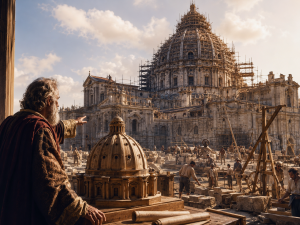 The industrial age handed builders materials the master builders never had, and each one rewrote what was possible.
Iron came first. In 1709, Abraham Darby became the first to smelt iron with coke, and in 1777-79 his grandson’s foundry cast the world’s first great iron structure, the 100-foot bridge over the River Severn at Ironbridge, England, its arches reduced to a spidery web of slender ribs. (China had been building iron-chain suspension bridges since the early Ming dynasty, and iron tension chains already ringed the domes of St. Peter’s and St. Paul’s.)
Then steel, and the sky opened. The second industrial age, beginning around 1880, ran on steel and electricity. Steel built the Eiffel Tower for the Paris Exposition of 1889, but the more consequential revolution was quieter: in Chicago, where land values were exploding, the architect-engineer William Le Baron Jenney answered the demand for taller buildings with the 10-story Home Insurance Company Building in 1885, the first large-scale use of steel in a building. George A. Fuller’s Tacoma Building followed in 1889, the first structure whose outside walls carried none of the building’s weight; Bessemer-steel cages carried it all. Combine the steel frame with the elevator, central heating, electric pumps, and the telephone, and you get the skyscraper, a word coined in the 1880s. By 1913, Cass Gilbert’s Woolworth Building stood 793 feet over Manhattan.
Concrete came back, with steel inside it. John Smeaton modernized ancient mortar in the late 18th century, Joseph Aspdin patented Portland cement in 1824, and in the 1850s the French builder François Coignet made the first iron-reinforced concrete. His all-concrete house in Paris, built in 1862, still stands, which the Romans would appreciate.
And glass became a wall. Plate glass was perfected in the late 19th century, the Pilkington float-glass process standardized production in 1952, and the glass curtain wall, a non-load-bearing skin hung on the structure, went from a single experimental façade on San Francisco’s Hallidie Building in 1918 to the default skin of the postwar skyline, once air conditioning, fluorescent lighting, and synthetic sealants made the all-glass tower livable after 1945.
The Eads Bridge: A July 4th Story About Quality Control
One project captures the new era better than any other, and it opened on the Fourth of July. After Congress authorized a bridge across the Mississippi at St. Louis in 1867, the commission went to James B. Eads, a self-taught engineer who had never designed a bridge, over eminent rivals including John Roebling, the designer of the Brooklyn Bridge. Eads proposed triple steel arches, with spans of 502, 520, and 502 feet, the longest ever constructed to that time, on piers sunk to bedrock 100 feet below the river using pneumatic caisson technology he had studied in Europe. When workers began developing decompression sickness, Eads built a floating hospital and mandated slower decompression.
Then there was the steel. Eads specified 60,000 pounds per square inch, and when the steel arrived short of specification, he rejected it and sent it back for rerolling. Three times. The supplier he kept sending it back to was Andrew Carnegie. The bridge opened to great fanfare on July 4, 1874, immediately recognized as an engineering marvel. When engineers strain-tested it in 1949, seventy-five years later, they found it could carry 5,000 pounds per lineal foot, two-thirds more than its original design estimate. It still stands.
IN PLAIN ENGLISH, FROM COLBY
Why does a 150-year-old bridge still carry traffic over the Mississippi? Because one man with his name on the project sent Andrew Carnegie’s steel back three times, and Carnegie rerolled it three times. That’s what accountability looks like when the person who controls the work also bears the risk. Now flip it around. When I inspect a building that’s failing after eight years instead of eighty, I already know what I’m going to find: somewhere, somebody accepted the steel, so to speak. The wrong flashing, the cheaper mix, the skipped inspection. Nobody sent it back, because nobody’s own money was riding on sending it back. Gilgamesh’s poet said it four thousand years ago: inspect the brickwork. Somebody has to.
A Timeline of Building Technology
Building knowledge advanced unevenly but cumulatively, each era adding a material the next would take for granted:
| Material / Technology | Where | When |
|---|---|---|
| Timber and mud brick | Early Bronze Age | ca. 6000 B.C. |
| Fired brick (and the first true arches) | Mesopotamia | ca. 3000 B.C. |
| Cut stone | Egypt | ca. 2500 B.C. |
| Sticky-rice mortar | China | ca. 1500 B.C. |
| Concrete, mortar, and glass | Rome and Egypt | ca. 100 B.C. |
| Iron | Europe and China | ca. 1400-1800 A.D. |
| Steel, aluminum, reinforced concrete, structural and insulated glass | Modern era | 19th-21st c. |
That sticky-rice entry is not a joke, by the way. Chinese builders mixed powdered limestone with sticky-rice soup into a mortar so durable that a 600-year-old city wall in Nanjing built with it still stands.
From Master Builder to Modern Complexity
 The 19th and 20th centuries broke the unified craft apart. The explosion of new materials and methods, high-strength steel, reinforced concrete, structural and insulated glass, plate aluminum, geotechnical exploration, soils classification, environmental monitoring, multiplied what builders could attempt: hundred-story towers, interstate highways with cloverleaf interchanges, massive dams and power plants, airports, subways, and tunnels.
All of that capability had a price. No single person could design, build, and answer for a modern skyscraper. The master builder’s single craft fractured into dozens of specialized engineering disciplines and trades: structural, mechanical, electrical, plumbing, fire protection, elevators, curtainwall, roofing, sealants, and more. As projects grew larger and the public’s exposure to their failure grew with them, government stepped in with building codes, permitting, construction safety regulation, and designer and contractor licensing, the modern descendants of the qualification standards Vitruvius begged Rome to adopt.
The scale of the modern industry is hard to overstate. Construction is the largest single segment of the production sector of the United States economy. Professor Thomas Stipanowich’s landmark study in the Wisconsin Law Review put it at as much as 13 percent of gross national product, directly employing one of every twenty American workers, and described the industry’s web of overlapping contracts as “a veritable mine field of conflict.” The numbers have only grown since: U.S. construction spending crossed $2 trillion in 2024 according to Deloitte’s industry outlook, and Oxford Economics forecasts a cumulative $135 trillion in global construction output in the decade to 2030, with the United States contributing roughly $14.9 trillion of it. More money now flows through construction contracts than through almost any other kind of agreement Americans sign, and its technical complexity is without parallel.
The Throughline: Building Is Risk, and Risk Must Be Allocated
Strip 4,000 years down to one idea and it is this: every act of construction is an act of risk. The ground may be unsuitable. The cost may run over. The work may fail. Civilizations that built well, and wrote down who bore the risk when things went wrong, prospered. The ones that did not, left ruins for archaeologists.
Hammurabi carved the answer in stone. Ephesus took it out of the architect’s estate. Rome wrote it into contracts backed by pacta sunt servanda. And modern construction law, from the Texas Property Code to the thickest set of contract documents on a Houston high-rise, is just the long, detailed answer to the same ancient questions: Who controlled the work? What did the contract actually promise? And who agreed to bear the risk that it would fail?
What Does 4,000 Years of History Mean for a Texas Building Owner?
It means the law has always been on the side of the owner who got less than what was promised, and it means the questions in your case are older than the alphabet. When a building leaks, a foundation moves, a project blows its budget, or a contractor walks away from toppling walls, you are not asking for anything novel. You are asking Hammurabi’s question, and Vitruvius’s, and the Ephesian magistrate’s: the people who controlled this work promised a result, so why should the owner bear the cost of their failure?
Getting that answer in a modern Texas courthouse takes more than history. It takes working through inspection reports, contract documents, expert analysis, statutes of repose, and the layers of parties the modern industry put between you and the people who actually drove the nails. That is what we do for building owners across Texas, and our FAQ sobre defectos de construcción answers the practical first questions owners ask us.
IN PLAIN ENGLISH, FROM COLBY
Here’s the deal, and then I’ll let you go. A construction company doesn’t have a heart. It doesn’t have blood. What it has is a balance sheet, and the only language a balance sheet speaks is money. For four thousand years, the only thing that has ever made builders build right is knowing they’d pay if they built wrong. Hammurabi knew it, the Greeks knew it, and every insurance adjuster working a defect claim today knows it too, which is exactly why they fight so hard. So if your building is failing, do three things. Save every document. Photograph everything. And talk to a lawyer before the repose clock runs out, because in Texas that clock does not care how good your case is once it stops. That’s it. That’s the whole sermon. What questions do you have for me?
Key Takeaways
- Construction predates agriculture at humanity’s oldest monumental site: Göbekli Tepe’s seven-ton pillars were raised roughly 11,000 years ago by pre-farming societies, and building projects likely drove the formation of settled civilization itself.
- The first construction defect law is nearly 3,800 years old. Hammurabi’s Code §§ 229-233 made builders liable for collapses, required compensation for ruined property, and forced builders to repair defective walls at their own cost.
- The “master builder” model, one person designing, directing, and answering for the work, governed construction from antiquity through Michelangelo and Jefferson, and survives today as design-build.
- Vitruvius, Rome’s chief engineer, urged architects in 20 B.C. to learn the law and draft careful contracts, and praised a Greek law making architects personally liable for cost overruns above 25 percent.
- Roman contract law’s pacta sunt servanda, “contracts must be kept,” still underpins modern strict contract liability under the Restatement (Second) of Contracts.
- Industrialization shattered the unified building craft into dozens of specialized trades and brought codes, permits, and licensing. Construction is now the largest single segment of the U.S. production sector, with spending above $2 trillion a year.
- Every construction dispute, ancient or modern, turns on the same questions: who controlled the work, what was promised, and who bears the risk of failure.
Preguntas frecuentes
What is construction law?
Construction law is the body of contract, tort, statutory, and regulatory law that governs the design and construction of buildings and infrastructure, including who bears the risk when a project fails, runs over budget, or is built defectively. Its core principles trace back thousands of years, to Hammurabi’s builder-liability code and Roman contracting practice.
What was the first construction law in history?
The earliest known construction law appears in the Code of Hammurabi, carved in Babylon around 1750 B.C. Sections 229 through 233 punished builders whose defective houses collapsed, required them to compensate owners for ruined property, and obligated them to fix defective walls at their own expense, even before any collapse.
What is a master builder, and does the role still exist?
The master builder was the single professional, historically called the architect, who both designed a project and directed its construction, answering personally for the result. Michelangelo at St. Peter’s and Thomas Jefferson at the University of Virginia both worked this way. The model survives today as the design-build project delivery method.
Who was Vitruvius and why does he matter to construction law?
Marcus Vitruvius Pollio was architect and engineer to Julius Caesar and Augustus and the author of de Architectura (ca. 20 B.C.), the only architectural treatise to survive from antiquity. He advised architects to learn the law and draft careful contracts so that “the interests of both employer and contractor may be wisely safe-guarded,” making him arguably the first construction lawyer on record.
Why are construction disputes so complicated today?
Because the unified master-builder role fractured into dozens of specialized parties: owners, developers, architects, engineers, general contractors, subcontractors, suppliers, construction managers, sureties, and insurers, each with separate contracts and separate insurance. When a defect appears, responsibility must be traced through all of those layers, which is why construction defect cases are document-intensive and expert-driven.
What should a Texas building owner do after discovering a construction defect?
Document the defect thoroughly with photographs and dated records, preserve all contracts and project correspondence, avoid destructive repairs before the condition is documented, and consult a construction defect attorney promptly. Texas imposes strict deadlines, including statutes of limitations and a statute of repose, that can bar even strong claims if an owner waits too long.
Coming Next in the Foundations Series
The master builder is gone, and something far more complicated took his place. In the next post, we follow Bruner & O’Connor into the modern era to answer the question this history sets up: why is a modern construction project the most legally complex transaction most owners will ever sign? We’ll look at the dozens of parties on a single job, the web of contracts that connects them, and why the legal system had to invent an entire field, construction law, just to keep up. If this post explained where building came from, the next one explains why building disputes are unlike any other fight in American law.
Want to make sure you don’t miss it? The full series will live in our Centro de conocimiento.
About the Author
- Colby Lewis is a seventh-generation Texan, trial lawyer, and the founder of El bufete de Colby Lewis, with offices in Houston, San Antonio, Corpus Christi, McAllen, and Brownsville. Over a two-decade career he has recovered more than $200 million for his clients, including public entities such as Harris County, the Houston Community College system, and dozens of Texas school districts and cities in construction defect and insurance matters. He is AV Preeminent rated by Martindale-Hubbell, has been named a Texas Super Lawyer every year from 2016 through 2026, and was named to the Top 100 Houston Super Lawyers list for 2025 and 2026. He represents building owners, not builders, in construction defect litigation across Texas. Conoce a Colby, or call (866) 265-2948.
Sources and Authorities
This post is part of a series exploring the historical foundations of construction law. Principal authorities:
- Philip L. Bruner & Patrick J. O’Connor, Jr., Bruner & O’Connor sobre derecho de la construcción § 1:1 (2026 update) (the organizing framework and historical survey this series follows)
- The Code of Hammurabi §§ 229-233 (L.W. King trans., 1910) (ca. 1750 B.C.), Yale Law School, Avalon Project
- Martha T. Roth, Mesopotamian Legal Traditions and the Laws of Hammurabi, 71 Chi.-Kent L. Rev. 13 (1995)
- Marcus Vitruvius Pollio, de Architectura (ca. 20 B.C.) (Morris Hicky Morgan trans., 1914), full text at Project Gutenberg
- Restatement (Second) of Contracts ch. 11, intro. (1981)
- Wilfrid Prest, Blackstone as Architect: Constructing the Commentaries, 15 Yale J.L. & Human. 103 (2003)
- Thomas J. Stipanowich, Restructuring Construction Law: Reality and Reform in a Transactional System, 1998 Wis. L. Rev. 463
- Carl M. Sapers, Ruminations on Architectural Practice, 25 Constr. Cont. L. Rep. ¶ 106 (2001)
- Michael Scott, A Passion for the Remarkable (the Eads Bridge), 21 Constr. Law. 46 (Spring 2001)
- Stephen Mitchell, Gilgamesh: A New English Version (2004); Herodotus, The Histories (ca. 450 B.C.); Plutarch, Pericles (ca. 75 A.D.); Julius Caesar, Gallic War (ca. 52 B.C.); Genesis 11:3-9; Matthew 7:24-27; Luke 14:28-30; 1 Corinthians 3:10
- Andrew Curry, The World’s First Temple?, Smithsonian (Nov. 2008); Andrew Lawler, Archaeology (Sept./Oct. 2013) (Uruk); Zach Zorich, The Pyramid Effect, Scientific American (Nov. 2015); David Macaulay, Building Big (2000); John H. Lienhard, Vitruvius, Engines of Our Ingenuity No. 580, University of Houston
- Graham Robinson et al., Future of Construction, Constr. L. Letter (Jan.-Feb. 2022) (Oxford Economics global forecast); Deloitte, 2025 Engineering and Construction Industry Outlook (2024); U.S. Bureau of Labor Statistics, Monthly Labor Review (Jan. 2012)
*This article is for general information only and is not legal advice. Reading it does not create an attorney-client relationship. If you believe your property has a construction defect, consult a licensed Texas attorney about your specific situation and deadlines.
